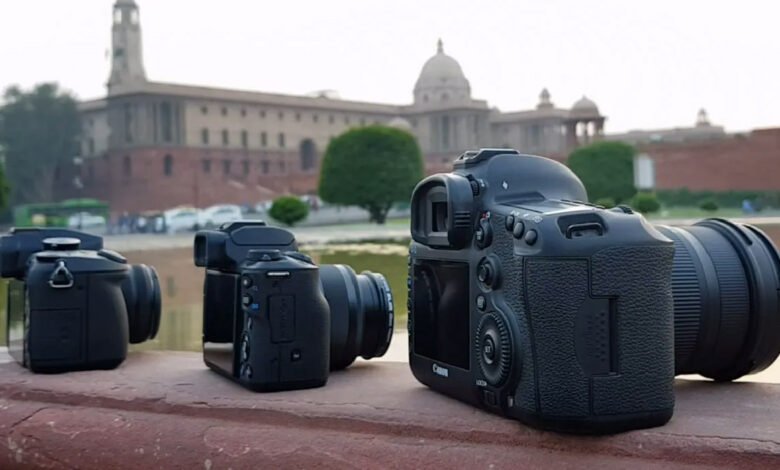
One of the first big decisions photographers face when moving into interchangeable-lens systems is sensor size. Within the Canon mirrorless camera range, that usually means choosing between full frame and APS-C bodies.
On paper, it can look like a technical spec battle: millimetres, crop factors, megapixels and model names. In practice, the choice is really about how you shoot, what you shoot and how you want your images to feel. Understanding what each format does well makes it much easier to invest in a body and lens setup that will grow with you.
What Does “Full Frame” Actually Mean?
A full frame sensor is roughly the same size as a traditional 35mm film frame (about 36 x 24 mm). That larger physical area allows each photosite (pixel) to be bigger at the same resolution compared to a smaller sensor.
In real-world shooting, full frame often gives you three main benefits: better performance in low light because those larger photosites can capture more light; shallower depth of field at the same field of view and aperture, which helps when you want strong subject separation; and wider true angles of view, since your lenses behave “as labelled” with no crop factor applied.
This makes full frame bodies particularly attractive for portrait, wedding, landscape and commercial work where image quality, tonality and background blur are top priorities.
What Is APS-C and Why Do People Choose It?
APS-C sensors are smaller, typically around 22 x 15 mm in Canon systems. Because the sensor covers a smaller area, it effectively crops into the image circle of your lens, giving you a narrower field of view. On Canon APS-C bodies, this crop factor is about 1.6x.
That crop has two big effects. First, it gives you extra “reach” with telephoto lenses. A 200mm lens behaves like a 320mm equivalent in terms of framing, which is very handy for wildlife, sports and distant subjects. Second, APS-C bodies and lenses can often be made smaller, lighter and more affordable than their full frame counterparts.
If you travel a lot, hike long distances, or shoot action on a tighter budget, APS-C can be a very practical and powerful choice.
Image Quality: How Big Is the Real-World Difference?
Full frame sensors generally offer cleaner files at higher ISOs and a wider dynamic range, which means they can hold detail in bright highlights and deep shadows more easily. This is noticeable when you are shooting in challenging light: low-lit receptions, night street scenes, high-contrast landscapes at sunrise or sunset.
APS-C sensors have improved dramatically in recent years. For many uses—daylight shooting, web delivery, social media, small to medium prints—the difference may not be obvious to non-photographers. Where full frame really earns its keep is when you are pushing files hard in post-production, printing big or regularly working in low light.
So the question is less “which is better on a lab chart?” and more “how demanding are my shooting conditions and how far do I need to push my files?”
Depth of Field and Background Blur
Because full frame sensors are larger, you get a shallower depth of field at the same framing and aperture compared to APS-C. This is why full frame is so popular for creamy background portraits and cinematic shallow-focus looks.
On APS-C, you can still achieve beautiful blur, especially with fast primes (for example, f/1.4 and f/1.8 lenses). You may just need to work a little closer to your subject or choose slightly faster apertures to get the same level of separation as a full frame setup.
If your style leans heavily on blurred backgrounds—portraiture, fashion, some wedding work—this depth-of-field difference is worth considering carefully.
Reach, Framing and How You Shoot
The crop factor on APS-C bodies effectively turns standard telephoto lenses into longer lenses in terms of field of view. This can be a big advantage if you shoot distant subjects and don’t want to carry very heavy, very long glass.
For example, a 70–200mm zoom on APS-C frames more like a 112–320mm lens on full frame. That extra reach is fantastic for field sports, birding and wildlife, where getting physically closer is not always possible.
On the other hand, if you are a landscape shooter who loves ultra-wide perspectives, or an interior photographer working in tight spaces, full frame makes it easier to get genuinely wide angles without extreme lenses.
Size, Weight and Handling in the Real World
Full frame bodies and lenses tend to be larger and heavier, especially when you move into professional telephoto zooms and fast prime sets. For some photographers, that extra weight is a worthwhile trade-off for the performance and feel of the system. For others, it becomes a barrier to actually taking the camera out.
APS-C kits can be significantly lighter and more compact. This matters more than spec sheets suggest when you are carrying gear all day at an event, hiking with a backpack, or travelling with limited luggage. The best camera is still the one you are willing to bring with you; a slightly smaller system can lead to many more real-world shots.
Budget and Long-Term System Planning
Full frame bodies and lenses usually cost more upfront. If you are just starting out or upgrading from a phone or compact camera, APS-C can be a smart way to access interchangeable-lens flexibility without stretching your budget too far.
What often makes sense is thinking in terms of a system roadmap. You might begin with an APS-C body and a couple of versatile lenses, then plan future upgrades that keep you within a family of compatible glass. Later, if you decide to move into full frame, you can carry some of those lenses forward, particularly those designed for the full frame mount.
Retailers like Diamonds Camera make it easier to compare bodies and lenses side by side within the broader mirrorless cameras category, so you can see how different combinations affect price, weight and capability.
Which Should You Choose?
There is no one-size-fits-all answer, but a few patterns can guide you.
If you prioritise the highest image quality, shoot a lot in low light, love ultra-shallow depth of field, and are prepared to invest more in lenses, a full frame body in the Canon EOS R line is likely to serve you very well.
If you value reach for sports and wildlife, want a lighter kit for travel or everyday use, and need to keep costs contained while still enjoying excellent performance, an APS-C Canon mirrorless body is an excellent fit.
Both formats are capable of professional results. The best choice is the one that fits your subjects, your style and your budget today, while leaving room to grow tomorrow. Understanding how full frame and APS-C differ inside the Canon mirrorless ecosystem means your next upgrade will feel less like a guess—and more like a confident step toward the images you actually want to create.