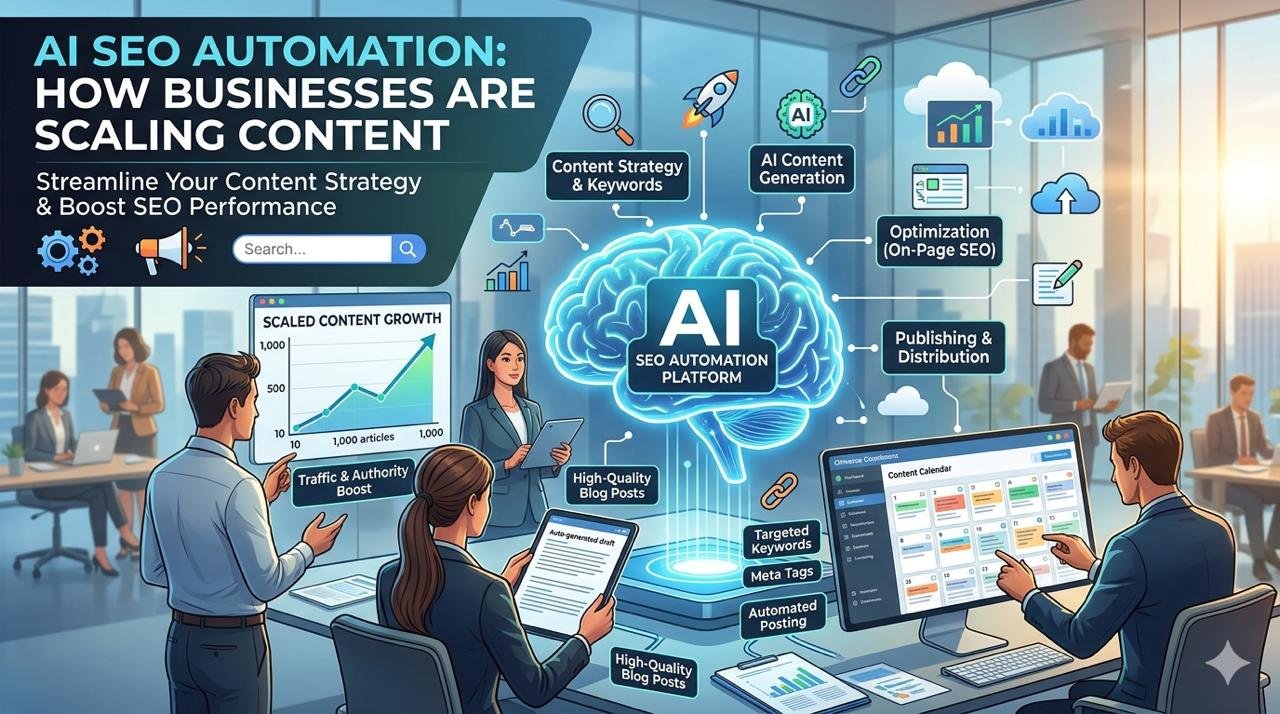
The Old Playbook Is Broken
Somebody at a mid-size e-commerce company once told me they spent four months and $30,000 producing 60 blog posts. Six months after publishing, three of them ranked. Three. The rest sat buried on page seven, generating nothing. That’s not a content problem. That’s a strategy problem compounded by a scale problem, and it’s more common than most marketing teams want to admit.
AI SEO automation is the answer a lot of businesses stumbled into accidentally before they fully understood what they were dealing with. Now the ones who understood it early are pulling ahead in ways that are hard to close.
What AI Actually Does to Search Strategy
SEO used to live inside spreadsheets and instinct. A good strategist could read a SERP, spot a gap, and build a content plan around it. That skill still matters. What’s changed is the volume of data that strategy now needs to account for.
Google processes over 8.5 billion searches daily, according to Internet Live Stats. Each one is a signal. Each SERP is a map of what Google currently believes satisfies user intent for that query. No human team can read thousands of those maps simultaneously and build content architecture around what they reveal. Machine learning systems can, and they do it in the time it takes to schedule a kickoff call.
Platforms like MarketMuse and Clearscope analyze topical relationships across millions of indexed pages, then tell a writer exactly which concepts need to appear in a piece to compete at a given difficulty level. That’s not keyword stuffing logic. That’s semantic architecture, and it’s why AI-assisted content consistently outperforms intuition-based content when both are executed with equal editorial care.
The Real Economic Argument
A 2023 McKinsey report on generative AI productivity found that knowledge workers in content-heavy roles experienced efficiency gains between 40 and 70 percent when AI tools were integrated into their workflows. Apply that to an SEO content program and the math changes fast.
What once required a team of six producing 20 articles monthly can now be a team of three producing 60, at comparable or higher quality with proper editorial oversight. For agencies providing digital marketing services in the USA, that shift rewrites the economics of client retainers entirely. Deliverable volume goes up. Turnaround time compresses. Client outcomes improve. The shops that haven’t absorbed this yet are quoting the same rates for a fraction of the output their AI-enabled competitors deliver.
Research Before the First Word
The piece most people skip is where AI delivers the most unnoticed value. Content research. Before any writer opens a document, AI tools have already mapped the competitive terrain.
Ahrefs and Semrush identify which keywords carry genuine traffic potential versus which ones look good on paper but convert nothing. Clearscope’s published performance data shows content earning an A grade on their platform outranks lower-graded content by over 40 percent in average position. That’s the difference between a content brief built on data and one built on assumptions. Good research doesn’t guarantee good rankings, but bad research almost always guarantees bad ones.
Generating Content That Holds Up
Google’s March 2023 guidance update was explicit. The algorithm targets unhelpful content, regardless of how it was produced. AI-generated content that genuinely serves users is not penalized. That’s the official position.
The practical reality is that raw AI output rarely meets the depth threshold without editorial work. What experienced content teams do is use AI for structural coverage, then layer in original analysis, verified data, and brand voice at the editing stage. The AI covers the breadth. The editor brings the substance. When that division works, the resulting content competes with anything produced entirely by hand, often faster and at lower cost.
On-Page Signals at Scale
Title tags, heading hierarchy, meta descriptions, schema markup, internal linking, Core Web Vitals. Every one of these elements affects how Google reads and ranks a page. Managing them manually across a site with hundreds of pages is where most SEO programs quietly fall apart.
Surfer SEO, Alli AI, and Conductor now offer real-time on-page scoring that runs while content is being written or edited. According to Conductor’s 2023 State of SEO report, enterprise clients using AI-assisted on-page tools cut average time-to-publish by 35 percent while improving content quality scores simultaneously. That’s not a marginal operational improvement. For a team publishing at volume, it’s the difference between a content program that builds momentum and one that treads water.
Scaling Without Destroying Quality
Doubling publishing volume without a content architecture strategy doesn’t build authority. It fragments it. This is the mistake businesses make most often when they first get access to AI content tools. They publish more and rank less, then blame the technology.
Real estate SEO is the clearest illustration of scale done right. Agencies that offer real estate SEO services have built location-specific content at a depth that was previously impossible to maintain. An Austin real estate SEO company producing 300 hyper-local pages covering specific neighborhoods, school attendance zones, new development permits, and local market trends is building a topical authority moat. Each page targets a specific user intent. Collectively, they signal to Google that the site is the authoritative source for that geographic market. No single page carries the weight. The cluster does.
Personalization and the Behavioral Signal Loop
AI personalization connects two things that SEO teams used to treat separately: content performance and user behavior. Using session data and machine learning, platforms now serve content variations based on user segment, referral source, or geographic location.
According to Salesforce’s 2023 State of Marketing report, 73 percent of customers expect personalized experiences from brands they engage with. Businesses delivering that see lower bounce rates and longer average session durations. Those behavioral signals feed directly into how Google evaluates page quality. Personalization, when it’s built on genuine user data rather than gimmicks, improves organic performance as a downstream effect of improving the experience itself.
Audits That Don’t Take a Month
A traditional content audit meant pulling traffic data from Google Analytics, cross-referencing it with Search Console, building a spreadsheet, categorizing pages by performance tier, identifying cannibalization, flagging thin content, and writing recommendations. Weeks of work for a large site.
ContentKing, now operating under Conductor, monitors site content in real time and surfaces issues the moment they emerge. Declining pages get flagged before they lose significant ranking ground. Crawl errors appear immediately rather than in a quarterly review. That shift from periodic auditing to continuous monitoring means SEO teams spend less time diagnosing problems they could have prevented.
Link Building With Better Targeting
Outreach-based link building has always suffered from one core inefficiency: volume prospecting with low hit rates. AI has improved this by scoring prospects based on relevance, domain authority, and content alignment before anyone sends a single email.
Platforms like Respona use AI to match content assets with high-fit outreach targets and personalize pitch messages based on each site’s recent content. Responsa’s published case studies report outreach conversion rates running two to three times higher than generic manual campaigns. At scale, that multiplier matters enormously.
Tracking What’s Coming, Not Just What’s Already Happened
Ranking reports are history. By the time a weekly rank tracking report shows a page sliding from position four to position nine, the damage has already started. AI-powered monitoring tools now provide predictive signals, identifying which pages are beginning to lose momentum before the drop becomes material.
Semrush’s Position Tracking and similar features inside Ahrefs give SEO teams leading indicators rather than lagging ones. That’s a fundamentally different kind of decision support.
The Limitations Nobody Advertises
A 2023 Stanford University study on large language model outputs found measurable rates of factual inaccuracy across multiple AI platforms. For content touching health, finance, legal, or other high-stakes categories, that makes human fact-checking mandatory, not optional. AI doesn’t know what it doesn’t know, and it will state an incorrect figure with the same confidence it states a correct one.
Competitive saturation is the other honest limitation. As AI adoption spreads across content teams, the floor for content quality rises. The advantage from AI tools alone diminishes. What compounds is AI tools combined with genuine subject-matter expertise and editorial standards.
Where Rainstream Technologies Fits
The businesses building durable organic growth right now use AI to handle what AI handles well and keep human judgment where it genuinely counts. Rainstream Technologies builds these integrated systems for clients across the country, from real estate SEO services for property firms to full-scale digital marketing services in the USA. If your content program isn’t compounding the way it should, the architecture is likely the problem, and that’s exactly where the work starts.
Final Thoughts
The window to build an AI-assisted content advantage that competitors can’t easily close is not permanently open. The businesses treating this as an infrastructure decision rather than a tool subscription are the ones whose organic channels will still be growing three years from now.
FAQs About AI SEO Automation
Does Google penalize AI content?
No. Google penalizes low-quality content. Its March 2023 guidance update confirmed that helpful AI-produced content is treated identically to helpful human-written content.
Can small businesses use AI SEO tools effectively?
Yes. Most leading platforms offer tiered pricing that mid-market and smaller teams can access. The productivity gains typically offset the cost within the first few months.
How long before AI-assisted SEO shows results?
Realistic timelines run three to six months for competitive keywords in established markets. Lower-competition niches often move faster.
Is human oversight still necessary?
Always. AI manages execution. Strategy, editorial judgment, and factual accuracy require human accountability at every stage.
Will AI-generated content rank on its own?
Not usually. Raw AI content rarely performs well without editing. It needs structure, fact-checking, and some level of original input to compete.
Is using AI for SEO considered risky?
It depends on how it’s used. Automating low-quality, mass content can backfire. Using AI to support research, structure, and optimization is generally safe and effective.
Do AI SEO tools replace traditional SEO skills?
No. They change how work gets done, but fundamentals still matter. Understanding search intent, content structure, and user behavior is still essential.