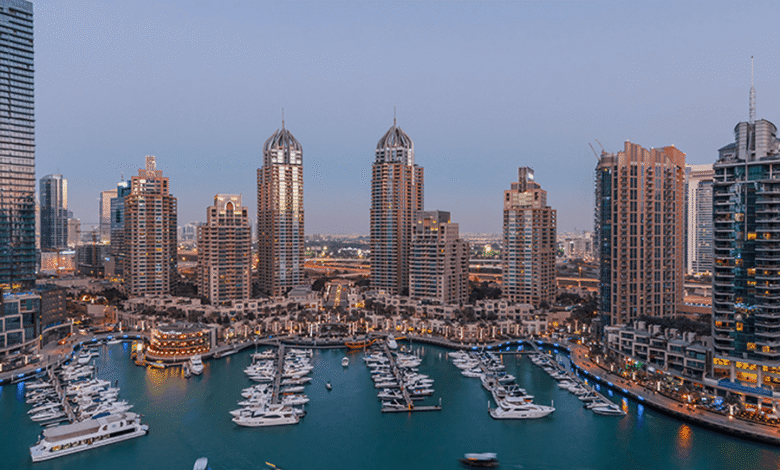
Dubai keeps appearing on shortlists that five years ago would have been London, Monaco, and New York. That shift did not happen by accident, and it is not purely about price. The city has assembled a combination of conditions that serious buyers looking for luxury property find difficult to match anywhere else.
Understanding what those conditions are and why they hold up under scrutiny is more useful than the headline comparisons.
The Tax Position Is Structural, Not a Policy
No income tax, no capital gains tax, no inheritance tax. For a high-net-worth buyer considering where to hold significant real estate, these are not minor considerations. In London, a property sale with a large gain has a meaningful tax consequence. In Dubai, it does not. That difference compresses over the holding period of a luxury asset into a number that changes the comparison entirely.
This is not a temporary incentive or a political offer that could change with the next election. It is embedded in how the UAE economy is structured. Buyers who engage in long-term planning view it differently than a tax break that is just one budget away from revision.
What Real Estate Developers in Dubai Are Delivering at the Top End
The product that real estate developers in Dubai are bringing to market at the luxury level has genuinely improved over the past decade. The finishes, the architecture, the amenity offer within a development, and the quality of the master planning around it. Palm Jumeirah established what was possible early. What has come since, the branded residences, the waterfront villa communities, and the ultra-high-end tower products, has raised the benchmark further.
Branded residences, in particular, have significantly shifted the discourse at the highest end of the market. A buyer purchasing in a Four Seasons, Bulgari, or Armani-branded development is buying into a service standard and a management commitment that an unbranded product cannot match. Real estate developers in Dubai partnering with these brands have effectively imported a level of assurance that the international luxury buyer already trusts.
Safety and Stability Are Real Differentiators
People who move to Dubai from cities where personal safety is a daily background calculation notice these differences quickly. Walking at night is unremarkable. The rule of law is consistently applied. In some markets that compete for the same buyers, political stability is a key consideration for ten-year property decisions.
For families in particular, this is not an abstract consideration. It changes the daily experience of living somewhere. And for buyers choosing between cities where the assets are comparable, it becomes a deciding factor.
Buying Property in Dubai Is Simpler Than Most Markets
Foreign ownership of freehold property in designated areas has been permitted since 2002. The process of buying property in Dubai is straightforward by international standards. A sales and purchase agreement, a transfer through the Dubai Land Department, and a title deed. The transaction costs are known and fixed. There is no labyrinthine legal process, no local ownership requirement, no currency restriction on repatriation of proceeds.
The golden visa program added a residency dimension that changed the calculation for buyers who were previously treating Dubai property as an investment to be managed remotely. Above certain ownership thresholds a long-term residency visa is available. The asset becomes the basis for a life in the city rather than just an entry in a portfolio.
The City Keeps Adding Reasons to Stay
Dubai property luxury is not held up by scarcity. The city keeps building. What sustains it is demand that keeps arriving from new directions. European buyers responding to tax changes at home. Asian buyers looking for a stable neutral location. Regional buyers who have always understood the market and are now buying at higher price points as the product has improved.
The infrastructure investment has kept pace. Schools, hospitals, conveyance, cultural venues. A city actively building the things that encourage long-term residents to stay represents a changed proposition from one coasting on an early reputation.
People who have spent significant time here in the past few years do not believe the city has reached its limits. That sense of a place still building toward something is part of what makes it compelling to buyers who could afford to be anywhere.