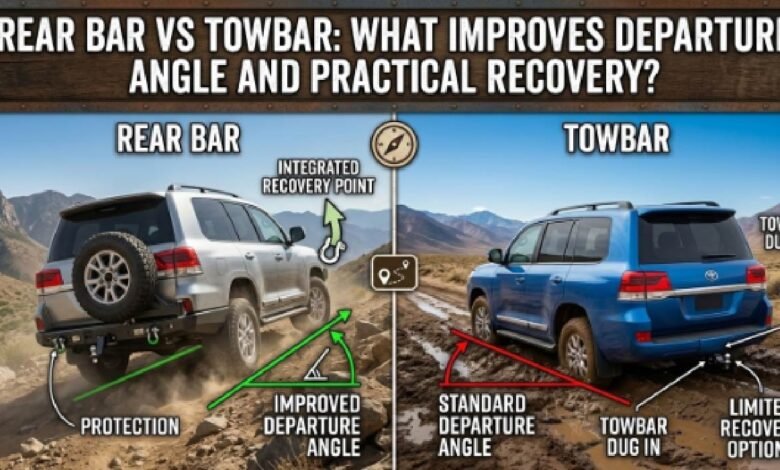
When people compare rear bar vs towbar, they usually start with towing capacity and stop there. Fair enough if the vehicle mostly pulls a trailer and lives on blacktop. But once the 4WD starts seeing rutted exits, creek banks, steep spoon drains, and the odd campsite track with a chopped-up departure, the question changes.
It stops being just a towing decision and becomes a departure angle and front-end protection style conversation for the rear of the vehicle, with recovery practicality thrown in for good measure.
That is where a lot of setups go wrong. A towbar can be brilliant for towing and still be the first thing to drag. A rear bar can clean up the tail of the vehicle and add protection, but it is not automatically the smarter buy if the rig spends its life hauling a box trailer around town.
A proper rear bar vs towbar decision comes down to what hangs low, what protects the body, and what gives you a safe recovery option when the track goes pear-shaped. The Rear Protection & Towing range is a good place to see how those choices split between simpler towing hardware and more integrated rear protection solutions.
Start With Departure Angle, Because the Ground Does Not Care About Your Plans
The departure angle is simple in real life. It is the moment you drive off an obstacle and the rear of the vehicle either clears it or drags its bum on the way out. You feel it straight away on washouts, ferry ramps, rock ledges, and uneven campsite entries.
From a practical point of view, anything mounted lower or farther rearward than the bumper line usually hurts departure angle. That is why a standard towbar with a tongue left in full time, or a drop hitch hanging under the rear, is often the first thing to kiss the dirt.
A tucked-up rear bar or rear protection and towing setup can improve that, especially when the receiver and protection are integrated higher and tighter into the rear end. But it is not magic. A badly designed rear bar can still hang low, and a neat towbar can still work fine if the vehicle is mostly used for towing rather than track work.
That is the first honest answer. If better departure angle is the main goal, a well-designed Protection Towbar or rear bar style setup usually gives you more to work with than a basic towbar.
A Towbar Still Makes Sense When Towing Is the Main Job
A towbar is not the budget option by default. It is the towing-first option. If the 4WD spends most of its life on-road with a camper, boat, work trailer, or small van, a proper towbar is often all you need.
That matters because towing gear is safety-critical. Queensland’s towing guidance says a properly designed and fitted tow bar is essential for safe towing, while WA’s safe towing bulletin says the towbar and coupling capacity must be at least equal to the loaded mass of the trailer.
It also says a towbar fitted to a vehicle built after January 1992 must be marked with its load capacity and model suitability or manufacturer part number. In other words, a random tow bar upgrade is not something to guess your way through.
There is also a day-to-day point people miss. Queensland recommends removable ball mounts, protective guards, or recessed designs because tow bars and tongues should not overhang dangerously or leave sharp corners sticking out when no trailer is connected.
That is not only a compliance matter. It is a shin-saver in car parks and one less metal bit hanging down when you leave the highway.
So if the main job is towing, a towbar remains a sensible answer. Just do not pretend it is the best answer for clearance and rear protection at the same time.
Rear Bar Benefits Show Up The Moment The Track Gets Ugly
This is where a rear protection towing setup earns its keep. A rear bar or protection towbar is not just there to hold a hitch. It changes how the back of the vehicle copes with awkward terrain and the odd knock.
The practical wins are pretty simple. A rear bar can protect lower quarter panels and the rear corners from scrub, steps, ledges, and reversing knocks. It can also clean up the tail visually and functionally if the design tucks in tighter than a basic towbar. On some builds, it is the difference between scraping metal on every steep driveway and getting through cleanly without wincing.
The protection towbar includes rear bumper bar and rear protection towbar options rather than just bare towing hardware, which is exactly why these systems get attention from tourers and drivers who leave sealed roads regularly.
That said, there is no point bolting on a heavy rear setup just because it looks tougher in the Bunnings car park. Extra weight still matters. If the vehicle already carries tools, drawers, a canopy, camping gear, or towball weight, the rear setup should suit the actual load and use.
Practical Recovery Is Where Most People Get Sloppy
This is the part worth slowing down for. A towbar is not automatically a recovery point, and a tow ball definitely is not.
An official Victorian 4WD winch safety document states plainly to never use a tow ball as a recovery point. The ACCC goes further and says recovery straps should only be used with proper robust recovery points, because normal attachment points such as tow balls, towbars, tow hooks, bull bars, and suspension components can break or snap off under strap loads. It also warns that serious injuries and deaths have happened with recovery straps used incorrectly.
That matters a lot in the rear bar vs towbar debate. For practical recovery, the better question is not “does it have a towbar?” It is “what is the rated recovery solution at the rear?”
If your setup uses a receiver hitch, then a rated recovery hitch is the clean and sensible way to use that receiver for recovery. A recovery hitch is designed to fit a tow bar receiver and provide a proper attachment point for a soft shackle. The Rated Recovery Points and Recovery Essentials, is the right way to think about recovery gear in the first place. Recovery is a system, not a guess.
So if practical recovery is high on your list, the winner is not simply “rear bar” or “towbar.” The winner is whichever rear setup gives you a legal towing solution and a properly rated recovery option without backyard nonsense.
Legal and Safety Checks Matter More Than Forum Opinions
This bit is not flashy, but it saves pain later. Towbars are covered by Australian Design Rule 62 for mechanical connections between vehicles, and both Queensland and WA transport guidance make the same basic point. Towing gear must be correctly designed, correctly fitted, correctly rated, and suitable for the vehicle and trailer combination.
That means checking the obvious stuff before buying anything:
- Vehicle-specific fitment
- Tow rating and ball download suitability
- Whether the hitch or receiver hangs too low for the terrain you drive
- Whether the setup leaves a safe rear profile when no trailer is attached
- Whether your recovery method uses a rated hitch or rated recovery points rather than a dodgy improvised attachment
There is no glory in discovering your rear end drags everywhere or your recovery plan relies on hardware never meant for that load.
So Which One Improves Departure Angle and Practical Recovery?
If towing is the main job and the vehicle rarely leaves formed roads, a standard towbar is usually the straightforward answer. It is simpler, often lighter, and does exactly what it is supposed to do.
If the vehicle sees rough tracks, steep exits, and regular touring work, a Protection Towbar or integrated Rear Protection & Towing setup usually gives you more rear-end protection and often a better shot at preserving departure angle.
That is especially true when compared with a low-hanging tongue or drop hitch left in place full time. For practical recovery, neither option should be trusted on vibes alone. The smarter move is pairing the rear setup with a rated hitch or proper recovery gear and keeping the towing side compliant.
Pick The Rear Setup You Will Actually Use Properly
The best rear-end setup is not the one with the toughest photo. It is the one that suits how the 4WD really works. If the vehicle spends weekends towing and weekdays commuting, keep it simple. If it sees hard exits, rutted campsites, and regular off-road travel, give front-end protection thinking a rear-end equivalent and treat clearance, rear body protection, and recovery hardware as part of the same decision.
That is usually where a trusted Australian 4WD accessories supplier becomes useful. Not for pushing the biggest bit of steel in the catalogue, but for helping match the right Rear Protection & Towing setup to the way the vehicle is actually driven.