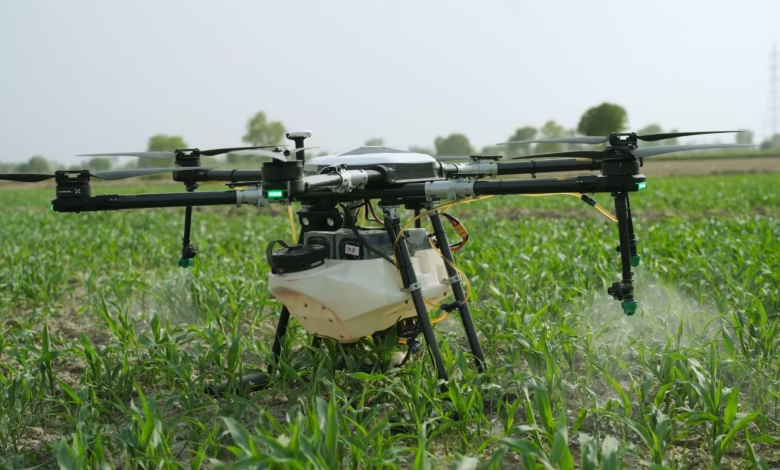
The global agricultural drone market is projected to reach $4.41 billion in 2026, growing at an explosive 29.8% CAGR. Meanwhile, China alone now operates over 300,000 agricultural drones — more than any other country in the world. The question is no longer whether drone spraying works, but which method Drones vs. Ground Sprayers deliver the best results for your specific operation.
This comprehensive guide evaluates both technologies across key metrics: cost, efficiency, spray coverage, field access, and environmental impact. The answer isn’t one-size-fits-all — but for many modern farmers, the scales are tipping decisively in favor of drones.
At a Glance: Drone vs. Ground Sprayer Comparison
| Dimension | Drone Sprayers | Ground Boom Sprayers |
| Upfront Investment | $30,000–$40,000 per unit | $250,000–$750,000 per self-propelled rig |
| Coverage Speed | 5–25 acres per hour per drone | 60–200+ acres per hour |
| Chemical Savings | 30–50% reduction typical | Baseline (blanket application) |
| Water Consumption | Up to 90% reduction | Standard (≥150 L/ha often required) |
| Labor Requirements | 1 pilot per fleet; remote operation | 1 operator per machine; intensive driving |
| Soil Impact | Zero compaction; no crop damage | Significant compaction risk; wheel damage |
| Weather Vulnerability | Moderate (sensitive to high winds) | Moderate (can operate in higher winds) |
| Pesticide Utilization Efficiency | 75.5–77.9% | 58.9% |
| Best For | Small/medium fields, orchards, vineyards, wet conditions, spot treatments | Large, uniform fields; high-volume broadacre spraying |
1. The Economic Case: Investment, Savings, and ROI
The Initial Cost Gap is Massive
The price differential is striking: a self-propelled ground sprayer can cost up to $750,000, while a high-performance agricultural drone typically runs $30,000 to $40,000. For farmers who already own tractors, tow-behind sprayers offer a lower entry point, but still require significant capital.
Operational Savings Add Up Fast
Drone spraying delivers dramatic ongoing savings:
- Chemical Reduction: Studies show drone spraying saves 30–50% on pesticide use compared to conventional methods, with some trials reporting up to 50% less chemical and 90% less water. For spot-spraying operations, efficiency can be roughly 3x greater with 20–60% less chemical.
- Fertilizer Savings: Variable rate application with drones saves 5–15% on fertilizer use.
- Labor Cost Reduction: Chinese farmers report paying just 40 yuan ($5.50) per mu for drone services, cutting manual spraying labor costs by approximately half.
In Greek vineyards, drone spraying generated annual savings of €278–377 per hectare on flat terrain and €367–538 per hectare on steep slopes compared to conventional methods. A Kenyan tea estate similarly reported 50% cost and time savings by switching to drone spraying.
African farmers using drones saw cost reductions of about 30% compared to conventional spraying.
Key Economic Takeaway
| Metric | Drone Advantage |
| Investment vs. Ground Sprayer | ~95% lower capital outlay |
| Chemical Savings | 30–50% |
| Water Savings | Up to 90% |
| Labor Savings | ~50% |
| Risk Reduction | Zero operator pesticide exposure; no soil compaction |
2. Spray Performance: Coverage, Penetration, and Efficacy
The Physics Advantage: Downwash Penetration
Unlike ground rigs that rely solely on hydraulic pressure, drone rotors generate “downwash” — a powerful downward airflow that actively drives droplets deep into the crop canopy. This gives drones a special advantage for penetrating dense foliage.
Pesticide Utilization Efficiency — the percentage of spray actually reaching the target — is 75.5–77.9% for drones, compared to just 58.9% for boom sprayers. Drone applications have increased dye concentration on corn ear leaves by 145.8% at certain sites due to superior deposition.
Corn trials showed that UAV and ground sprayer treatments produced higher upper leaf deposits than airplane applications.
For lower canopies, the downwash effect is particularly dramatic: Brazilian research found drones delivered up to 1.9 times more droplet deposition on the lower third of plants compared to ground methods.
Side Effects: Streaking and Drift Challenges
Drone spraying is not without challenges. The same downwash that enhances penetration also makes droplets more susceptible to drift, and achieving a perfectly uniform swath is more difficult. Ground sprayers can operate with their boom positioned merely centimeters from the canopy, giving them greater control.
Drift studies confirm that UASS (drone) spray drift is greater than ground boom sprayers. In one trial, drone passes showed spray drift and streaking with uneven coverage between rows.
The Weed Control Verdict
Drone vs. ground sprayer for weed control — which wins depends on conditions:
- Grass weed control: Both methods achieved 94–100% control.
- Mixed conditions: Ground sprayers provided more uniform coverage and steadier weed control, while drones showed potential for difficult-to-reach weed escapes.
- Low-volume success: Drones using low-drift nozzles at 1.0–1.5 gallons/acre achieved weed control comparable to ground sprayers at 10 gallons/acre. Applications of glyphosate and glufosinate using drones were as effective as ground spraying.
3. Application Speed and Field Capacity
The Raw Numbers
For sheer coverage speed, ground sprayers still lead: 60–200+ acres per hour for ground booms, compared to 5–25 acres per hour for a single drone.
The Gap is Closing
However, next-generation drones are closing this gap. Preliminary calculations suggest larger, faster drones could approach 40 acres per hour for fungicides and potentially over 100 acres per hour for broadacre herbicides. The DJI T50, for example, can cover up to 42 acres per hour for cotton.
In absolute terms, a single self-propelled sprayer will always outrun a single drone. The efficiency of multiple drones operating as a fleet, however, can approach parity.
4. Terrain Access and Soil Health
Where Ground Rigs Can’t Go
This is perhaps the most decisive advantage for drone technology. Drones:
- Never touch the ground — zero soil compaction, zero crop damage
- Operate in wet, muddy conditions when ground rigs would get stuck or cause permanent field damage
- Navigate irregular plots, terraced hillsides, and wet spots inaccessible to heavy machinery
- Protect soil structure — crushed soil from heavy machinery reduces pore space and hinders root growth
For cranberry bogs and other sensitive terrain, any intrusion must be minimized — drones provide the ideal solution. Drones also protect crops mechanically, as ground rigs risk running over and damaging plants.
5. Precision Agriculture and AI Integration
The drone advantage extends beyond spraying — modern agricultural drones are becoming full-spectrum crop intelligence platforms.
AI-powered drones with RTK positioning and real-time vision can now navigate and adapt dynamically without manual pre-mapping. Closed-loop autonomous systems can modify flight paths and droplet characteristics in real time.
Drones can simultaneously collect agronomic data for canopy density analysis, crop stress detection, spray effectiveness validation, and terrain profiling — generating value returns far beyond a single spraying pass.
6. Environmental and Sustainability Impact
Agricultural drones are delivering measurable environmental dividends. Globally, the existing fleet has helped save 222 million tons of water and reduced CO₂ emissions by 30.87 million tons.
- Water savings of 80–90% per application
- Lower carbon footprint due to reduced chemical manufacturing and transport
- Reduced soil compaction preserves soil biology and carbon sequestration
- Lower operator exposure — “human-machine separation” protects applicators from pesticide contact
Which Technology is Right for Your Farm?
Choose Ground Sprayers If:
- Your operation covers thousands of contiguous acres
- Fields are large, flat, and well-drained
- Speed and volume are your absolute priority
- You have the capital for large equipment investment
Choose Drone Sprayers If:
- Your terrain is hilly, muddy, or irregular — drones can access land ground rigs cannot enter
- You are managing orchards, vineyards, or specialty crops — exceptionally strong drone performance for tree and vine crops
- You want dramatic reductions in chemical and water use
- You are a small-to-medium operation (or fleet operator offering services)
- You value integrated crop data along with spraying
- You want zero soil compaction and no crop damage
The Hybrid Approach
Most forward-thinking farms will employ both: ground rigs for large-scale burndown applications and aerial seeding, and drones for surgical spot treatments, late-season applications when fields are too wet, and orchards and vineyards that ground equipment cannot reach without damage.
Why Jinghong Drone is Your Trusted Partner
At Jinghong Drone, we understand that modern agriculture demands equipment that is precise, efficient, and built to last. As a leading manufacturer of agricultural spraying drones, we combine the advantages of cost-effective operation, superior downwash penetration, and zero soil compaction with the durability and reliability that farmers worldwide demand.
Our agricultural drone solutions incorporate:
- High-efficiency spraying systems achieving up to 90% water savings
- Precision navigation technology for consistent coverage
- Durable construction designed for daily field operations
- Versatile configurations adaptable to crops from rice to orchards
- Professional support from initial purchase through ongoing maintenance
Ready to transform your farming operation? Explore our full range of agricultural spraying drones at jinghongdrone.com and discover why farmers worldwide are making the switch.
Frequently Asked Questions (FAQs)
Q: How much can I save by switching to drone spraying?
Drone operators typically achieve 30–50% chemical savings and up to 90% water savings. In vineyard applications, annual savings of €278–538 per hectare have been documented.
Q: Is drone spray coverage as effective as ground sprayers?
In many cases, yes — and for dense canopies, drones’ downwash can actually increase lower-canopy deposition. However, under high-wind conditions or for applications requiring extremely uniform patterns, ground rigs still have an advantage.
Q: Can drones handle large fields?
Yes, with caveats. A single drone covers 5–25 acres per hour; larger models approach 40+ acres per hour. For very large, uniform fields, ground sprayers still offer faster absolute coverage, but multiple drones operating as a fleet can close the gap.
Q: Are spraying drones difficult to operate?
Modern agricultural drones feature intuitive controls, automated flight planning, and RTK precision navigation. Professional training is recommended, and many manufacturers offer comprehensive training programs.
Q: Do drones work in orchards and vineyards?
Yes — drones excel in tree and vine crops where ground access is challenging. Their downwash effect penetrates dense canopies effectively, and they avoid mechanical damage to plants.
Conclusion
The choice between drones and ground sprayers isn’t about which technology is “better” — it’s about which is right for your specific needs.
For large-scale, flat, well-drained fields where speed is paramount, ground sprayers remain the efficiency champion. But for orchards, vineyards, wet fields, hilly terrain, and operations seeking dramatic chemical and water savings, drones are not just an alternative — they are the superior solution.
Agricultural drone spraying has moved beyond pilot projects and entered the mainstream. With the global market growing at nearly 30% annually and China now operating over 300,000 units, the evidence is clear: drones are here to stay, and they are transforming modern farming.
Here’s what farmers can confidently expect from a well-integrated drone spraying program: 30–50% less chemical, up to 90% less water, 50% less labor, zero soil compaction, and a healthier crop with less environmental impact.