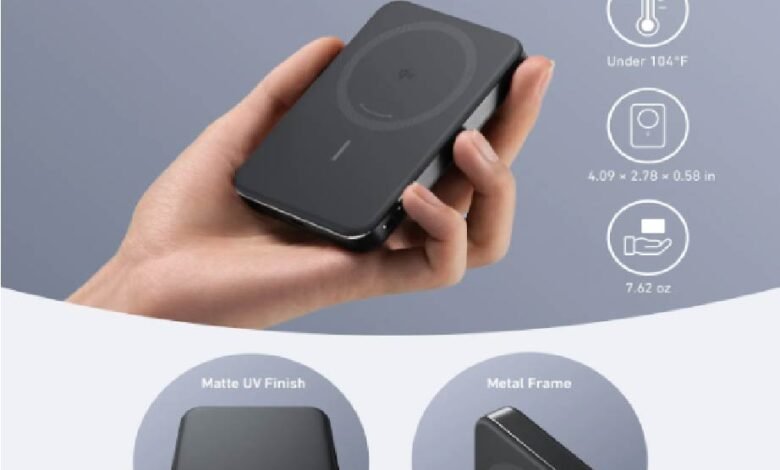
In the modern world that is constantly connected, a portable charger is not a luxury anymore, but a necessity. Long commuting and traveling hours to power failure and excessive screen time, a good portable power bank can keep your phone alive when you need it the most. Having written and researched consumer tech accessories over the course of more than a decade, I have observed that the gravest error people commit is not selecting the wrong brand, but instead the wrong capacity. The guide will enable you to make a solid choice of the appropriate power bank capacity to use on your phone, and not the marketing propaganda.
Understanding What Power Bank Capacity Really Means
The capacity of the power bank is in milliampere-hours (mAh). On the face of it, the larger the mAh, the better, however, capacity is not the whole story. A 10,000mAh portable charger does not provide a 10,000mAh charge to your phone based on the loss of energy conversion, heat and the cable efficiency. Practically, you tend to achieve between 65-75 percent of the rated capacity.
This will aid in making realistic expectations and avoiding paying too much to exceed capacity that you might never utilize.
How to Match Power Bank Capacity With Your Phone Battery
Each smartphone has a size of its battery, which is typically between 3,000mAh and 5,000mAh. In order to select the appropriate portable power bank, first, you need to check the battery capacity of your phone and then multiply it with the number of full charges that you desire.
Assuming that your phone has a 4,000mAh battery and you desire a single full charge, then a 5,000-6,000mAh power bank should be adequate. A 10,000mAh portable charger is a safer option when it comes to two full charges. The 15,000mAh or more should be considered by the heavy users who are dependent on navigation, gaming, or mobile hotspot capabilities so that they do not run out unpredictably.
Choosing Capacity Based on Lifestyle and Usage
What is important is your daily routine, not the specifications of your phone. A slim portable charger with an average capacity should be convenient and not bulky to those who spend most of their time at an office or a student who is not far away and has access to a wall outlet. Portable power banks with greater capacity are usually used by travelers, outdoor enthusiasts, and remote workers and can last several days.
Personally, I have noticed that frequent travelers would much more regret purchasing small power banks than larger ones. It is annoying to run out of power when on a layover or on a road trip- but easily prevented with the right capacity selection.
Portable Charger Size, Weight, and Charging Speed
Increased capacity tends to be heavier and larger and this affects portability. The size of a power bank is small enough to fit into a pocket or a small bag, whereas 20,000mAh power banks are more appropriate in a backpack. Balance matters.
Another factor that has not been considered is speed of charging. A lot of new portable power banks have fast-charging technologies, and it is necessary that your phone has them as well. Even a high capacity portable charger with low output can take hours to charge your device. Such brands as Anker are reputable in terms of their ability to combine the capacity, speed, and safety options, and that is why they can be suggested by tech experts.
Portable Power Bank Capacity Recommendations at a Glance
In the case of emergency charging, 5,000-7,000mAh is sufficient to use on a daily basis. The most balanced and popular is 10,000mAh, which is chosen by average users who want to feel safe. The 15,000-20,000mAh models are expected to be the most reliable to power users, travelers, and professionals.
The trick here is to select capacity depending on your real usage of your phone- not on what appears fancy on the box.
Why Safety and Quality Matter as Much as Capacity
Not every mAh rating was made equal. Inexpensive non-brand name portable chargers can overstate capacity and do not have adequate safety features. An effective portable power bank must also have a temperature control, surge protection, and short-circuit protection. I have over the years tried several units where the quality of the batteries is poor and thus they wear out easily or they do not wear out at all after a few months.
You can be sure that your phone will perform well in the long-term investing in a well-known brand and proven ability.
Conclusion
The choice of the correct portable charger does not lie in purchasing the highest capacity, but the smartest one that suits your lifestyle. Learning about the mAh, considering the real-life performance, and selecting a reliable portable power bank, you can be sure of a constant supply of power at the time when it really counts. A wise decision today will keep you alive tomorrow with dead batteries.
FAQs
What is the best capacity of portable charger to use in smartphones?
The optimal capacity is based on the size of the phone battery and the frequency of use. The majority of users can agree that a portable power bank with a 10,000mAh capacity is the best size-performance ratio.
Will a high capacity portable power bank harm my phone?
No, an adequately engineered portable charger will just provide the amount of power that your phone can safely receive. The low quality of chargers that lack safety measures tends to cause damage.
What is the number of times that a phone can be charged by a portable charger?
This is based on the capacity of the power banks and the size of your phone batteries. An average smartphone has a power consumption of about 2000mAh, which means that a 10,000mAh power bank can charge it twice.
Is bigger better in terms of portable charger?
Not necessarily. Increased capacity implies increased weight and increased recharge periods. The correct size will make it convenient without any extra bulk.