Morocco welcomed 4.3 million international tourists in Q1 2026 alone – a 7% increase on the same period in 2025, according to the Ministry of Tourism, Handicrafts, and Social and Solidarity Economy. March 2026 stood out as a record month, with approximately 1.6 million arrivals – an 18% year-on-year rise. That momentum follows an already record-breaking 2025, in which Morocco recorded 19.8 million total tourist arrivals, a 14% increase on 2024, making it the most-visited country in Africa.
That growth generates real economic value: tourism ranks as the second-largest contributor to Morocco’s GDP. But it also places measurable strain on water resources, fragile desert ecosystems, and centuries-old cultural traditions. Morocco is already ranked among the 27 most water-stressed nations globally by the World Resources Institute, with water availability projected to decline by 25% across all economic sectors.
Sustainable travel in Morocco is not a niche preference – it is the practical framework that determines whether the country’s most extraordinary landscapes and communities remain intact for future visitors. This guide covers 8 evidence-based practices that responsible tourists apply when exploring Morocco.
What Does Sustainable Travel in Morocco Actually Mean?
Sustainable travel in Morocco rests on 3 interconnected principles: environmental stewardship, economic equity, and cultural preservation. Each principle shapes specific decisions – from where a traveler sleeps to how they move between cities.
Morocco has formalized this approach at the governmental level. Since 2006, more than 60 Moroccan cities have signed a charter for responsible tourism. The country hosted COP7 in Marrakech in 2001 and COP22 in 2016.
The government’s Tourism Strategic Roadmap 2023–2026, supported by the World Bank, prioritizes rural ecotourism, climate-resilient coastal tourism, and community-based hospitality as core pillars of national tourism strategy.
These efforts create a foundation. Responsible tourists build on that foundation through their daily choices.
1. Conserve Water – Especially in Desert Regions
Water conservation is the single most pressing environmental obligation for tourists in Morocco. The World Bank and Moroccan financial institutions have projected that declining water availability could cause a 6.5% decrease in GDP – making water stewardship a national economic issue, not just an ecological one.
Hotels, restaurants, and tourist facilities compete directly with agriculture and local households for limited water supplies, especially in arid southern regions like Merzouga, Zagora, and M’Hamid el Ghizlane.
A standard tourist shower consumes the equivalent of one nomadic family’s weekly water supply. Eco-resorts and responsible travel operators in the Sahara recommend limiting shower use to 1.5 liters or less per wash, turning off taps when not in active use, and participating in hotel towel-reuse programs.
Travelers visiting the Draa Valley, the Erg Chebbi dunes, or gateway towns to the Sahara encounter water stress in visible, immediate ways. Applying conservation habits consistently – not only at camps but throughout the entire trip – reduces the cumulative burden on local water infrastructure.
2. Choose Eco-Certified and Locally Owned Accommodations
The accommodation a traveler selects determines who benefits from their spending. Riads and dars – traditional Moroccan courtyard houses found in the medinas of Fez, Marrakech, and Chefchaouen – provide authentic lodging experiences and, when locally owned, channel revenue directly into resident communities.
Morocco operates 3 formal sustainability certification systems for accommodations: the Green Key label for hotels that meet environmental management standards, the Blue Flag designation for beaches meeting coastal quality standards, and the Moroccan Trophies for Responsible Tourism, launched by the Ministry of Tourism in 2008.
The World Bank’s Blue Economy Program actively supports coastal tourism businesses – including surfing schools in Agadir – to install solar panels and reduce carbon emissions under Morocco’s 2023–2026 roadmap.
Before booking, travelers confirm whether properties have installed solar panels, greywater recycling systems, or low-flow fixtures. Responsible operators answer these questions with concrete examples rather than generalized claims.
3. Support Local Artisans and Family-Owned Businesses Directly
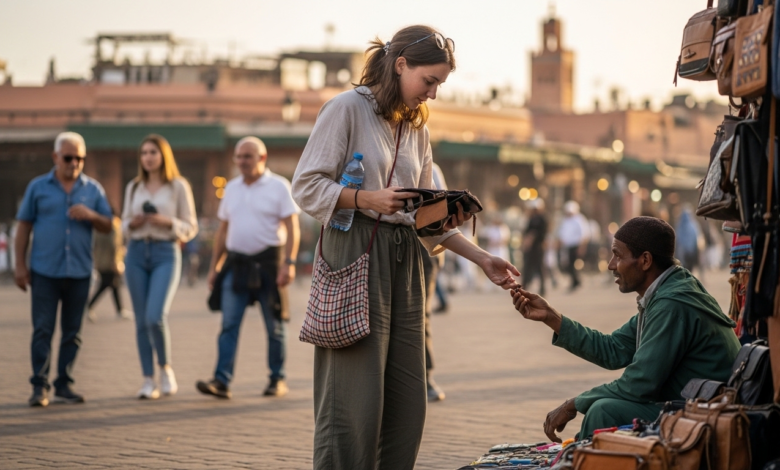
Purchasing handcrafted goods directly from artisans in cooperatives, workshops, and souks in cities like Fez, Essaouira, and Tiznit eliminates intermediary markups and ensures that revenue reaches the craftsperson.
Morocco’s artisan sector includes pottery in Fez’s medina, woven textiles from Amazigh cooperatives in the Atlas Mountains, and leather goods from tanneries operating under traditional guild structures.
Dining at family-operated restaurants rather than international chains preserves culinary authenticity and circulates income within local households. The same principle applies to hiring local guides over large multinational operators – a practice that directly funds community livelihoods in regions where formal employment options are limited.
Morocco’s tourism sector directly employed 600,000 people in 2023, with total tourism-related employment – including informal roles in desert and rural communities – reaching 1.8 million.
4. Travel During Shoulder Seasons to Reduce Overcrowding
Morocco’s most visited destinations – Marrakech, Fez, and the Erg Chebbi dunes near Merzouga – experience significant overcrowding during peak summer months.
World Bank research projects that by 2030, nearly 70% of tourists indicate they would change destination if temperatures became uncomfortably high due to climate change – a particular risk for the Mediterranean and North African region.
Traveling between March and May or September and November distributes visitor pressure more evenly across the year and coincides with Morocco’s most temperate climate conditions. Shoulder-season travel reduces competition for limited water resources and lowers the noise and erosion impact on sensitive desert ecosystems.
January 2026 data confirms that off-peak travel is increasingly viable: arrivals from France rose 14%, Poland 40%, the United States 15%, and Canada 10% compared to January 2025 – demonstrating a well-serviced year-round tourism infrastructure.
5. Minimize Plastic Waste with a Refillable Water Bottle
Tap water in Morocco is considered safe to drink in most urban areas, including Marrakech, Rabat, Agadir, and Fez. Carrying a reusable water bottle and refilling it rather than purchasing single-use plastic significantly reduces the volume of plastic entering Morocco’s landfill infrastructure, which is not uniformly equipped to process high volumes of tourist-generated waste.
Beyond water bottles, travelers reduce plastic impact by refusing single-use bags at markets, choosing accommodations that use biodegradable amenities, and requesting no plastic packaging when purchasing food from street vendors and local restaurants.
Morocco’s National Action Plan encompasses 25 projects focused on renewable energy, energy efficiency, and reducing greenhouse gas emissions – individual traveler behavior reinforces rather than undermines this national strategy.
6. Book Responsible Desert Tours That Protect Fragile Ecosystems
The Sahara Desert is the most ecologically fragile zone in Moroccan tourism. Off-road 4×4 driving outside established pistes damages desert dune formations and disrupts the fauna and flora of Erg Chebbi and Erg Chigaga. Responsible desert operators restrict vehicles to established tracks and offer trekking and camel-led alternatives for terrain that is accessible on foot.
Group size is a reliable indicator of a tour operator’s commitment to sustainability. Genuine sustainable operators limit desert groups to 8–12 participants, use reusable containers for camp meals, and partner with local conservation organizations in communities like Merzouga and M’Hamid.
Morocco’s 2023–2026 roadmap specifically identifies desert regions around Ouarzazate and Errachidia as priority zones for sustainable tourism development – the same areas that recorded 35% and 29% year-on-year visitor growth respectively in January 2026.
When comparing operators, travelers ask 4 specific questions: maximum group size, vehicle policies in sensitive dune areas, waste management at desert bivouacs, and the percentage of guides hired from local Berber communities.
Morocco Desert Tours that prioritize local employment and small-group itineraries reflect the standards that align with responsible tourism principles across these rapidly growing southern destinations.
7. Respect Cultural Norms and Religious Practices
Morocco is a predominantly Muslim country. Responsible tourist behavior in cultural contexts includes dressing modestly in medinas and rural areas – covering legs, arms, and shoulders – refraining from public displays of affection, and observing Ramadan protocols by avoiding eating, drinking, or smoking in public during daylight hours in the presence of fasting locals.
Photographing people, particularly in rural Amazigh communities in the Anti-Atlas Mountains and High Atlas villages, requires explicit permission. Entering mosques without invitation is not permitted at most sites. Learning basic phrases in Darija (Moroccan Arabic) or Tamazight demonstrates cultural respect and is consistently received positively by local residents.
The Amazigh (Berber) people – with a population of 30 to 40 million across North Africa, the majority in Morocco and Algeria – maintain distinct traditions, festivals, and craft practices.
Engaging with Amazigh culture through locally led trekking tours in regions like Souss-Massa and the Ameln Valley supports indigenous economic participation rather than extracting cultural experiences without community benefit.
8. Explore Beyond the Overcrowded Highlights
Responsible tourism redistributes economic benefit and reduces environmental pressure on saturated sites. January 2026 data highlights where Morocco’s growth is accelerating fastest: Casablanca recorded 36% year-on-year visitor growth, Rabat 42%, Tangier 31%, Ouarzazate 35%, and Errachidia 29% – evidence that travelers are already discovering cities and desert regions beyond the traditional Marrakech–Fez circuit.
Practical alternatives to Morocco’s most saturated destinations include Taroudant (a walled trading city in the Souss Valley with the medina character of Marrakech and a fraction of its visitor volume), Oualidia (a coastal lagoon town less trafficked than Essaouira), and Al Hoceima National Park (a protected coastal area in northern Morocco with rich biodiversity and minimal infrastructure strain).
In the Atlas Mountains, hiking trails in the Ameln Valley and the Agafay Desert provide immersive landscape experiences without contributing to the visitor density that erodes cultural authenticity around the Toubkal base camp area.
Practical Takeaway: 8 Habits of a Responsible Tourist in Morocco
Responsible travel in Morocco produces measurable outcomes: more revenue reaches local communities, fragile ecosystems sustain lower impact, and cultural heritage remains accessible to future generations.
The 8 core habits are:
- Limit water consumption – particularly in desert and arid southern regions ranked among the most water-stressed in the MENA region
- Book locally owned, eco-certified accommodations – riads, dars, and Green Key-certified desert camps
- Purchase directly from artisan cooperatives and family businesses in Fez, Essaouira, and Atlas Mountain communities
- Travel during March–May or September–November to reduce pressure on high-traffic sites
- Carry a refillable water bottle and decline single-use plastics consistently
- Select small-group desert tour operators that hire local Berber guides and restrict off-road vehicle access in Erg Chebbi and Erg Chigaga
- Learn and apply cultural norms around dress, photography, and religious observance
- Explore high-growth emerging destinations – Casablanca, Rabat, Tangier, Ouarzazate – rather than concentrating visits on already-saturated medinas
Morocco’s target of 26 million visitors by 2030 – supported by 80 new air routes opened in 2025 and major 2030 FIFA World Cup co-hosting infrastructure – makes the decisions of individual tourists more consequential, not less.
The country’s landscapes, from the Sahara dunes of Merzouga to the cedar forests of the Middle Atlas, remain extraordinary precisely because they have not yet been fully degraded. Sustaining that status depends on how every visitor chooses to travel.
Sources: Morocco Ministry of Tourism, Q1 2026 Arrivals Report; ATTA, Morocco Tourism Roadmap 2023–2026; World Resources Institute Water Risk Atlas; World Bank Blue Economy PforR & Climate Resilience Study (2024); Directorate of Studies and Financial Forecasts (DEPF), January 2026 Tourism Data; MDPI Sustainability Journal (2025) – Morocco Water Stress Research.