The convergence of security technology and design thinking has transformed identification systems from purely functional tools into strategic assets. ID card printers now sit at the intersection of these disciplines, enabling organizations to deploy identification solutions that satisfy both rigorous security requirements and contemporary aesthetic standards. This evolution reflects broader shifts in how institutions approach access control, brand identity, and operational efficiency.
Modern ID card printers serve dual mandates that once seemed incompatible. They must produce credentials that incorporate sophisticated anti-counterfeiting measures while projecting the visual identity that organizations have carefully cultivated. This balancing act has made these devices essential infrastructure across corporate campuses, educational institutions, healthcare facilities, and government agencies—anywhere that managing physical and logical access intersects with organizational identity.
The technology underpinning these systems has matured considerably, moving from simple badge production to integrated platforms that connect with broader security ecosystems. Understanding this landscape requires examining how identification technology has evolved, how contemporary systems function, and what emerging innovations will reshape the field in coming years.
From Paper Badges to Smart Credentials
Identification technology has undergone fundamental transformations since organizations first formalized credentialing systems. Early approaches relied on paper-based documents with minimal security features—easily reproduced and difficult to verify at scale. The introduction of photographic identification represented a significant advancement, though these systems remained vulnerable to sophisticated forgery.
The integration of machine-readable technologies marked a pivotal shift. Magnetic stripe cards enabled automated verification and access logging, while barcode systems provided cost-effective alternatives for lower-security applications. These innovations laid groundwork for more sophisticated approaches, but each generation revealed new vulnerabilities as adversaries developed countermeasures.
Radio frequency identification fundamentally changed the security calculus. RFID technology introduced contactless verification, encrypted data transmission, and the ability to embed multiple security layers within a single credential. This advancement enabled the high-throughput access control systems that modern facilities require, while simultaneously raising the bar for would-be counterfeiters.
Contemporary ID card printers have evolved alongside these technological shifts, incorporating capabilities that would have seemed implausible decades ago. Today’s devices can encode multiple data formats, apply holographic overlays, embed microtext, and integrate with enterprise identity management platforms—all while maintaining the production speeds that large organizations demand.
How Modern ID Card Printers Function
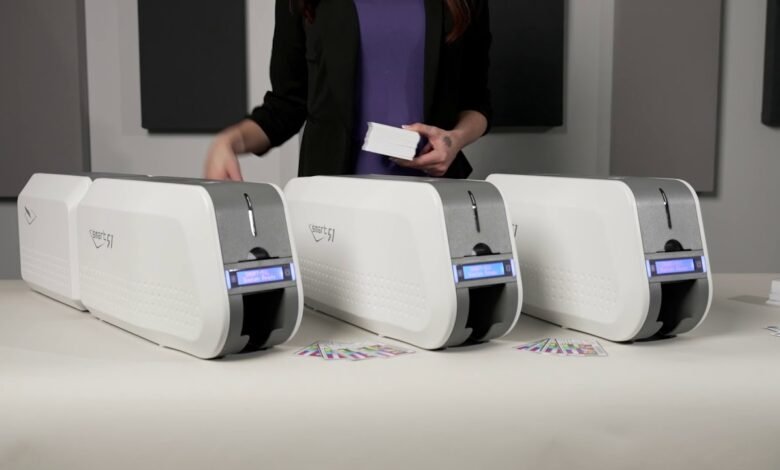
ID card printers employ specialized printing technologies designed specifically for credential production. Most professional-grade systems use dye-sublimation or reverse-transfer printing methods, each offering distinct advantages for different security and aesthetic requirements.
Dye-sublimation printers apply heat to transfer dye from ribbons onto card surfaces, creating images that resist fading and tampering. This process produces photographic-quality results suitable for credentials that must remain legible for years. Reverse-transfer systems print onto film that’s then thermally bonded to cards, enabling edge-to-edge printing and compatibility with smart card technologies that would otherwise interfere with direct printing methods.
The applications span numerous sectors, each with specific requirements:
- Corporate environments: Employee credentials that integrate with building access systems, time tracking platforms, and logical access controls for IT resources
- Educational institutions: Student and faculty IDs that enable facility access, library services, meal plan management, and event attendance tracking
- Healthcare facilities: Staff credentials that control access to sensitive areas while meeting regulatory requirements for patient data protection
- Government agencies: Official identification that satisfies stringent security standards and interoperates with national identity verification systems
For organizations evaluating systems across these sectors, vendors like IDExperts, BadgePass, and Zebra Technologies each offer solutions tailored to varying security and volume requirements.
Digital Credentials and Mobile Identity
The emergence of digital credentials represents perhaps the most significant shift in identification technology since the introduction of smart cards. Ecard IDs—digital representations of physical credentials stored on smartphones or other personal devices—are rapidly gaining adoption across sectors that previously relied exclusively on physical badges.
These digital alternatives offer compelling advantages that address longstanding pain points in credential management:
- Reduced replacement costs: Lost or forgotten physical cards generate significant administrative overhead and replacement expenses, while digital credentials remain accessible as long as users retain their devices
- Enhanced security options: Digital credentials can leverage device-native security features including biometric authentication, secure enclaves for cryptographic operations, and remote revocation capabilities that take effect immediately
- Streamlined provisioning: New credentials can be issued remotely without requiring users to visit security offices, enabling faster onboarding and reducing administrative burden
- Environmental benefits: Eliminating plastic card production aligns with sustainability initiatives while reducing the material costs and waste associated with traditional credentials
The transition to digital credentials doesn’t eliminate the need for physical ID card printers entirely. Most organizations adopt hybrid approaches that accommodate both credential types, recognizing that certain use cases—visitor management, temporary contractors, or environments where personal devices aren’t permitted—still require physical badges. This coexistence will likely persist as the technology matures and organizations navigate the operational and cultural changes that digital credentials entail.
Emerging Technologies Reshaping Identification
Several technological trends are poised to fundamentally alter how organizations approach identification and access control. These developments promise enhanced security and operational efficiency, though they also introduce new complexities that security professionals must navigate.
Biometric integration represents the most visible trend. Rather than relying solely on possession of a credential, systems increasingly verify the biometric characteristics of the credential holder. Fingerprint readers, facial recognition cameras, and iris scanners are becoming standard components of access control infrastructure, with credentials serving to initiate authentication rather than solely proving identity. This layered approach significantly raises the difficulty of unauthorized access, even when credentials are compromised.
Artificial intelligence is transforming identity verification processes. Machine learning algorithms can detect anomalous access patterns, identify potentially fraudulent credentials, and flag behavioral indicators that suggest compromised accounts. These capabilities enable security teams to respond to threats more rapidly while reducing false positives that erode user trust in security systems.
Blockchain technology offers intriguing possibilities for credential verification. Distributed ledger systems could provide tamper-evident records of credential issuance and revocation, enabling instant verification without requiring connection to centralized databases. This approach could prove particularly valuable for credentials that must be verified across organizational boundaries, though practical implementations remain limited as the technology matures.
These advances arrive alongside growing concerns about privacy and data protection.
Security Equipment as Organizational Infrastructure
The security equipment that supports identification systems extends well beyond the printers themselves. Comprehensive credential security requires attention to the entire production and management infrastructure, from secure storage of blank card stock through disposal of expired credentials.
Physical security for credential production facilities prevents unauthorized access to printing equipment and supplies. Compromised printers could enable adversaries to produce authentic-looking credentials that bypass access controls, making printer security a critical component of overall facility protection. Many organizations implement the same access restrictions for credential production areas that they apply to data centers or other high-security zones.
Supply chain security has emerged as a particular concern. Counterfeit printer ribbons or compromised card stock could introduce vulnerabilities that undermine even sophisticated security features. Organizations increasingly source supplies exclusively from authorized distributors and implement verification procedures to detect counterfeit consumables before they enter production workflows.
The integration of ID card printers with broader security infrastructure enables capabilities that isolated systems cannot provide:
- Centralized policy enforcement: Access rights defined in identity management systems automatically propagate to physical access controls, ensuring consistent security posture across digital and physical domains
- Audit capabilities: Comprehensive logging of credential production, modification, and usage supports compliance requirements and security investigations
- Incident response: Compromised credentials can be immediately revoked across all connected systems, limiting the window of vulnerability when security incidents occur
Organizations that view ID card printers as isolated devices rather than components of integrated security infrastructure miss opportunities to enhance both security and operational efficiency. The most effective deployments treat credential production as a security-critical process deserving the same attention as network security or data protection.
Strategic Considerations for Identification Systems
The landscape of identification technology continues evolving rapidly, driven by advances in printing technology, cryptography, biometrics, and mobile computing. Organizations face increasingly complex decisions about how to deploy and manage credential systems that will serve their needs for years to come.
Several key considerations should inform these decisions:
- Scalability requirements: Systems must accommodate organizational growth without requiring wholesale replacement, making modular architectures and open standards valuable
- Integration capabilities: Credentials increasingly serve as keys to both physical and digital resources, requiring tight integration with IT infrastructure and identity management platforms
- Security feature requirements: Different environments demand different security levels, from basic visual verification to sophisticated multi-factor authentication with biometric validation
- Total cost of ownership: Beyond initial hardware costs, organizations must account for consumables, maintenance, training, and the administrative overhead of credential management
- User experience: Security measures that create excessive friction generate workarounds that ultimately undermine security, making usability a security consideration rather than merely a convenience factor
The convergence of physical and digital credentials will likely accelerate, with organizations maintaining hybrid systems that accommodate both form factors. This transition period presents both opportunities and challenges, as security teams must ensure that new capabilities don’t introduce vulnerabilities while legacy systems remain in operation.
Looking forward, the most successful identification strategies will be those that treat credentials as components of comprehensive security ecosystems rather than standalone tools. As threats evolve and technology advances, the organizations best positioned to adapt will be those that have built flexible, integrated systems capable of incorporating new capabilities as they emerge.
For security professionals navigating these decisions, staying informed about technological developments and industry best practices proves essential. The identification systems deployed today will shape organizational security posture for years, making careful planning and strategic thinking critical to long-term success.