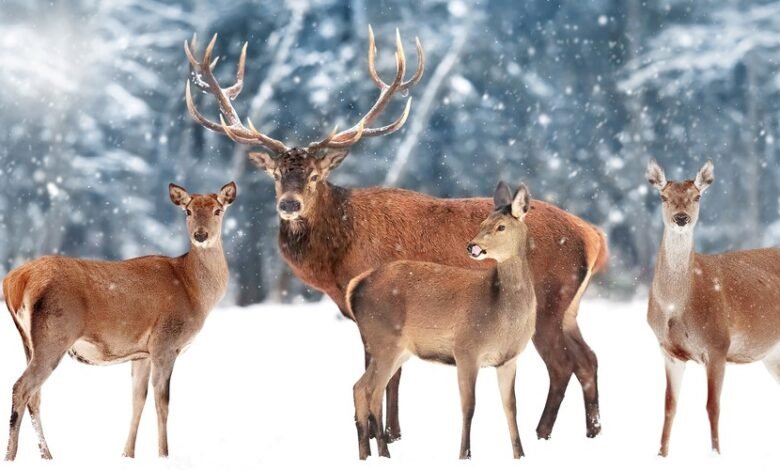
Few wildlife encounters capture the spirit of western Canada quite like seeing a wild elk standing against a backdrop of snowcapped mountains. Known as wapiti in Canada, elk are among the largest members of the deer family, with mature bulls distinguished by their impressive branching antlers. During the autumn rut, their haunting bugles echo across valleys and forests, creating one of Canada’s most memorable wildlife experiences.
Canada offers numerous opportunities to encounter elk, but Alberta is particularly rewarding. From the open grasslands of Waterton Lakes to the mountain valleys of Banff and Jasper and the forests of Elk Island, several national parks provide outstanding opportunities to observe these magnificent animals.
For travelers hoping to see elk in Canada, these four national parks should be at the top of the list.
Jasper National Park
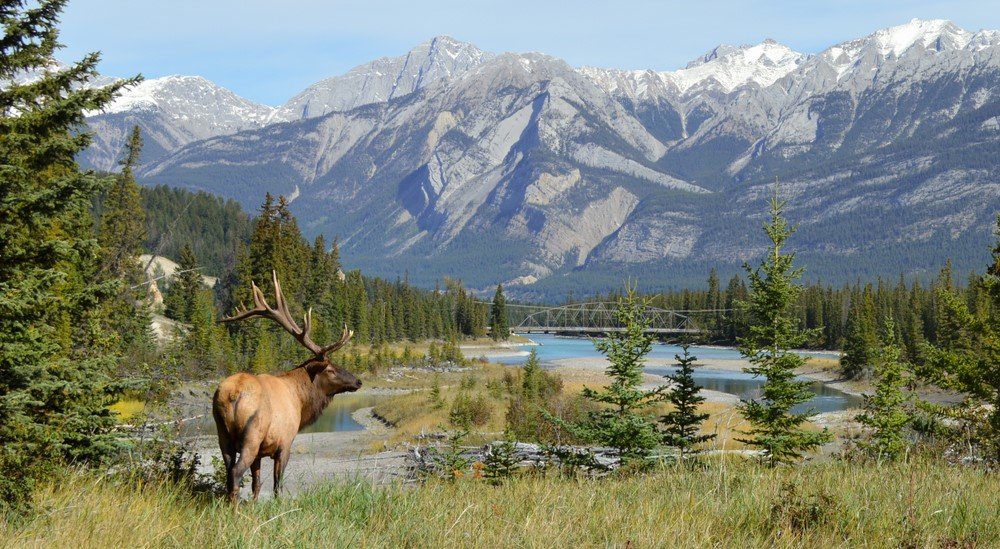
Jasper National Park is arguably Canada’s premier destination for combining elk watching with spectacular Rocky Mountain scenery. Elk are the park’s most commonly seen ungulates, and Parks Canada estimates approximately 375 live within Jasper National Park.
One reason Jasper is such a good elk destination is accessibility. Visitors don’t necessarily need to venture deep into the wilderness to find them. Elk can frequently be seen along roadsides, in open areas of the Athabasca Valley, and even around the Jasper townsite.
September is an especially exciting time to visit. This is the elk rut, when mature bulls compete for females. Their distinctive bugling calls can often be heard in the early morning and evening, and visitors may encounter bulls guarding groups of cows or challenging rival males.
For the best opportunity to see elk, explore the lower valleys around Jasper during the first few hours after sunrise or again in the evening. Drive slowly through promising habitat and scan open meadows and forest edges rather than concentrating solely on the road immediately ahead.
The combination of accessible wildlife and enormous mountain scenery makes Jasper difficult to beat. An elk encounter is impressive anywhere, but seeing a mature bull framed by the Canadian Rockies elevates the experience considerably.
Waterton Lakes National Park
Waterton Lakes National Park may offer Canada’s most dramatic opportunity to see large gatherings of elk.
The park occupies an extraordinary transition zone where prairie grasslands meet the Rocky Mountains. Those open grasslands are particularly valuable for elk because they provide abundant forage while simultaneously giving visitors long, unobstructed views.
Elk are the most numerous large animals in Waterton Lakes National Park. During summer, herds disperse and many animals move toward higher elevations. As fall arrives, however, the situation changes dramatically. Elk gather into larger herds, and Parks Canada reports that hundreds can sometimes be seen around the Blakiston Fan and other prairie areas during fall and winter.
That makes Waterton an excellent destination for travelers who want to experience elk as a herd rather than simply spotting individual animals.
Late summer and fall are particularly productive wildlife-viewing periods. Autumn also brings the rut, when visitors may hear bugling bulls and see large harems gathering on the grasslands. The Blakiston Fan, located between Lower and Middle Waterton lakes, is one of the areas worth watching closely.
Plan wildlife drives for early morning and late afternoon, when animals tend to be more active. Waterton’s relatively open landscape is an advantage for photographers because elk can often be observed from considerable distances without needing to approach them.
Banff National Park
Banff National Park may be Canada’s most famous national park, but its spectacular scenery sometimes overshadows the fact that it is also an outstanding elk destination.
Parks Canada describes elk as the park’s most abundant large animal, with close to 350 living within Banff National Park. More than 200 are found in the lower Bow Valley near the town of Banff.
The Bow Valley’s lower-elevation montane environment provides excellent habitat. Open forests, grasslands and relatively mild winter conditions create favorable grazing areas, while the valley itself serves as an important wildlife corridor.
Visitors can encounter elk throughout the park, including surprisingly close to developed areas. Two particularly good places for photographers to scout are Vermilion Lakes Drive and the road around the Banff Springs Golf Course.
Spring and fall require additional caution. Cow elk can become highly defensive while protecting newborn calves during spring, while mature bulls become aggressive during the autumn rut.
Wildlife watchers should never mistake an elk’s familiarity with people for tameness. Parks Canada recommends remaining at least 30 meters — roughly three bus lengths — from elk. When viewing wildlife along roads, visitors should remain in their vehicles whenever possible and use a telephoto lens rather than approaching for a closer photograph.
Elk Island National Park
If the primary objective of your trip is simply to find elk, Elk Island National Park deserves serious consideration.
Located only about 48 kilometers east of downtown Edmonton, the park provides an unusual combination of accessibility and abundant wildlife. It was originally established in 1906 to protect one of Canada’s remaining elk herds, giving the park an important place in the country’s wildlife conservation history.
Today, Parks Canada reports that Elk Island supports more than 1,000 elk, making it one of Canada’s most important elk strongholds.
The experience here is different from Banff or Jasper. Instead of towering alpine peaks, visitors explore a rolling landscape of forests, grasslands, wetlands and lakes. These diverse habitats support elk as well as moose, deer and both plains and wood bison.
Early morning is one of the best times to explore. Parks Canada specifically recommends morning visits for better wildlife-viewing opportunities, quieter trails and reduced traffic.
Drive slowly, watch openings between the trees and spend time scanning meadow edges. Hiking can also provide opportunities, but wildlife should always be given plenty of room. Elk Island’s bison are another major attraction, so visitors searching for elk may encounter some of Canada’s other iconic large mammals along the way.
When Is the Best Time to See Elk in Canada?
Elk can be observed throughout the year, but September and early October provide one of the most memorable experiences.
This is the rutting season. Mature bulls carry their full antlers, gather groups of females and announce their presence with powerful bugling calls. Early mornings can be particularly atmospheric as those calls travel across cool mountain valleys.
For photographers and wildlife enthusiasts, the basic strategy is simple: start early, stay late and look for open habitat adjoining forests. Elk frequently move between protective tree cover and grasslands where they feed.
Above all, keep your distance. Elk are powerful wild animals. Bulls can become especially unpredictable during the rut, while cows vigorously defend calves during spring. Give them room, never feed them and never position yourself between members of a herd.
For mountain scenery and memorable photography, Jasper and Banff are difficult to surpass. For the possibility of witnessing large herds, Waterton Lakes stands apart. And for travelers interested primarily in maximizing their chances of encountering elk, Elk Island National Park may be Canada’s ultimate elk destination.
Together, these four national parks reveal why Alberta deserves to be called Canada’s elk country.