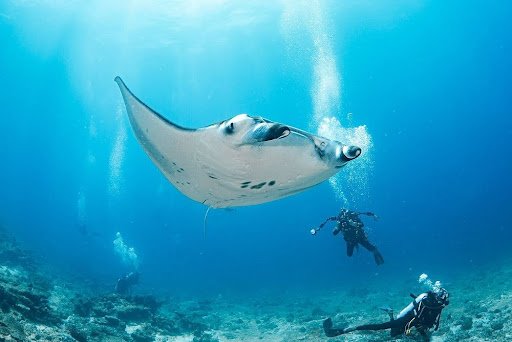
Some diving experiences are impressive. Diving with manta rays is something else entirely. The moment a manta banks toward you — wings spread wide, cephalic fins curled, moving through the water with the kind of effortless grace that makes everything else seem clumsy — you understand immediately why divers travel thousands of kilometres just to be in this position.
The Maldives is where this happens best. Here’s everything you need to know.
What Makes Manta Rays So Extraordinary to Dive With
Manta rays are not like most marine animals. They don’t hide in coral. They don’t bolt when they sense your presence. They arrive on their own schedule, to specific sites, for predictable reasons — and they allow divers to share their space in a way that feels almost like an invitation.
There are two species in Maldivian waters. The reef manta (Mobula alfredi) is the more commonly encountered, with a wingspan typically reaching 3 to 4 metres. The oceanic manta (Mobula birostris) is the larger of the two, with wingspans occasionally exceeding 6 metres. Both species are present in the Maldives, and both are classified as vulnerable on the IUCN Red List — which is why responsible diving practices matter enormously here.
Mantas are highly intelligent. They have the largest brain-to-body ratio of any fish. They recognise individual divers. Some researchers believe they are capable of self-awareness. Spending time in the water with them is not just a thrilling dive — it’s an encounter with a genuinely remarkable animal.
Why the Maldives Is the Best Place in the World for It
Over 5,000 individual manta rays have been identified in Maldivian waters — one of the largest known populations anywhere on the planet. The Maldives’ unique geography does the work: its atolls create channels and shallow bays that concentrate plankton, and plankton is what mantas travel for.
The result is predictability. Mantas return to the same cleaning stations day after day. Guides know which sites produce encounters at which time of year. Operators have spent years tracking individual animals by the unique markings on their ventral (underside) surfaces — just like fingerprints.
This isn’t a destination where you hope to see a manta. It’s one where you plan around seeing them.
The Best Manta Ray Dive Sites in the Maldives
Manta Point — North Malé Atoll
One of the most famous manta diving sites in the world. Reef mantas visit this cleaning station daily, hovering at 12–15 metres while wrasses and angelfish pick parasites from their skin and gills. Divers settle quietly on the reef below and watch the mantas circle overhead in slow, mesmerising loops. It’s a meditative dive — calm, close, and deeply impressive.
Dhigurah Manta Point — South Ari Atoll
Reliable year-round sightings in sheltered, clear conditions. Smaller groups of mantas make encounters here feel more intimate. An ideal site for newer divers or anyone who wants unhurried time with these animals without heavy current or boat traffic.
Maaya Thila — Ari Atoll
A coral pinnacle that draws mantas at dawn and dusk. The site also delivers sharks, rich reef life, and the Maldives’ famous night diving — making it one of the most well-rounded dive sites in the country. Manta encounters here are less predictable but all the more memorable when they happen.
Lankan Manta Point — Addu Atoll
For oceanic mantas — the larger species. Located deep in the southern Maldives, this site rewards the journey. Best visited between December and April during the northeast monsoon. Encounters here tend to involve fewer divers and more dramatic blue-water conditions.
Hanifaru Bay — Baa Atoll
A UNESCO Biosphere Reserve, and one of the greatest wildlife spectacles on earth during peak season. Between June and November, plankton blooms draw aggregations of up to 200 mantas simultaneously. Scuba diving is not permitted here — snorkelling only — but the encounter still belongs on this list because no guide to manta diving in the Maldives is complete without it.
Cleaning Stations: The Heart of Every Manta Dive
The best manta dives in the Maldives happen at cleaning stations, and understanding what they are makes the whole experience richer.
A cleaning station is a specific coral outcrop or reef section where small cleaner fish — primarily wrasses and angelfish — gather to feed on the parasites and dead skin of visiting marine animals. Mantas arrive at these stations daily, often at predictable times tied to current and tide. They slow down, spread their wings, open their mouths, and hover patiently while the cleaner fish do their work.
The dive protocol at a cleaning station is simple: descend, settle onto the reef, breathe slowly, and do not move toward the mantas. You wait. They come to you. And when a manta banks in close — close enough to see the individual spots on its belly, close enough to watch its eye tracking yours — the patience pays off completely.
Best Time of Year for Manta Ray Diving
| Season | Months | Best Locations | What to Expect |
| Dry Season | Nov – Apr | Ari Atoll, Malé Atoll, Addu | Calm seas, excellent visibility, reliable cleaning station visits |
| Wet Season | May – Oct | Baa Atoll (Hanifaru), Ari Atoll | Plankton blooms, mass feeding aggregations, dramatic encounters |
Both seasons produce outstanding manta encounters — just different types. The dry season offers the clearest water and calmest conditions. The wet season brings the feeding spectacles that no other destination can match.
How to Dive with Manta Rays Responsibly
Manta rays are vulnerable to disturbance. The wrong behaviour from divers can cause them to abandon cleaning stations they’ve used for years. These are the rules every diver should follow without exception:
- Do not touch a manta ray — ever. Touching removes the protective mucus from their skin and opens them up to infection
- Do not chase a manta if it moves away
- Stay horizontal — vertical body position mimics a threat in manta body language
- No flash photography — it startles the animal
- Keep your fins clear of the reef — stirring up sand clouds disrupts the cleaning station
- Approach from the side, never head-on or from above
The Maldives’ manta population thrives because these rules are taken seriously. Responsible operators enforce them on every dive.
Why a Liveaboard Gives You the Best Manta Encounters
Resort day trips can deliver manta encounters, but a liveaboard changes the entire equation. Aboard the Spirit of Maldives, itineraries are built around where the mantas are — not around a fixed departure port. The boat moves between atolls, following seasonal patterns, current conditions, and live sightings reports.
That flexibility means multiple dives at the best sites, access to remote cleaning stations that day boats never reach, and expert guides who have spent years learning the behaviour of individual animals in these waters. Combined with the comfort of a 40-metre luxury vessel — Starlink internet, jacuzzi, gourmet meals, and spacious cabins — it’s the most complete way to experience manta ray diving the Maldives has to offer.
Final Thought
Manta rays are not a guaranteed sighting — no wildlife encounter ever is. But the Maldives comes closer to guaranteeing it than anywhere else on earth. The population is large, the sites are known, and the guides are exceptional. Go with a good operator, dive with patience, and the Maldives will deliver something you’ll be talking about for the rest of your diving life.