America’s Electric Tricycle Buyers Are Starting to Look Under the Hood — Here’s What the MaxFoot MF-33 Reveals

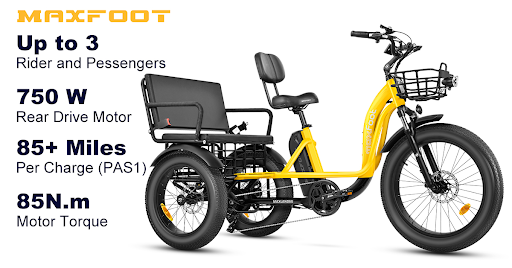
Shopping for an electric tricycle in the U.S. market usually starts with the numbers everyone advertises: watts, amp-hours, miles of range. Those numbers matter, but they don’t tell you whether the trike will still perform like new after two years of daily riding. That answer lives in the parts nobody photographs for the listing page — the frame alloy, the battery construction, and, easy to overlook, the wiring that carries power from battery to motor. The MaxFoot MF-33 is a useful case study in why those unglamorous details are exactly what separate a trike built to last from one built to survive its return window.
The Frame: Strength That Doesn’t Fatigue
Start with the structure everything else attaches to. The MF-33 uses a thickened 6061 aluminum alloy frame, a grade chosen specifically because it resists fatigue cracking under repeated load — a real concern on a trike designed to carry two adults regularly, not occasionally. It also resists corrosion better than lower grades of aluminum, which matters across the range of climates American riders deal with, from humid summers in the Southeast to salted winter roads in the Northeast. Combined with a low step-through design for easy boarding, the frame is the foundation the rest of the trike’s durability depends on.
The Motor and Differential: Power With Control
A 750W rated rear-drive motor with up to 1400W of peak power gives the MF-33 roughly 85 N·m of torque — enough to handle moderate hills and pull away from stops confidently, even fully loaded with a passenger. A rear differential automatically balances the speed of the left and right rear wheels through turns, reducing the tipping risk that shows up in simpler three-wheeled designs when cornering under load.
The Battery: Potted Cells for Heat and Safety
The Samsung 48V 20Ah battery, UL2271 certified, is built with a potting compound that fills the gaps between individual cells rather than leaving air pockets. That construction spreads heat evenly across the pack during hard acceleration, slows the capacity loss that comes from repeated cell expansion and contraction, and — most importantly — creates a physical barrier that helps stop a single overheating cell from triggering a chain reaction through the rest of the pack.
The Part Almost Nobody Talks About: The Wiring
Here’s where the MF-33 quietly does something most budget trikes skip. A 750W motor pulling 1400W at peak isn’t a trivial current draw, and every watt of that power has to travel from the battery to the controller to the motor through cables. If those cables are thin, or the copper inside them is low-grade, that current draw generates heat inside the wire itself — and under sustained high-power riding, thin or poor-quality cabling is a real fire and failure risk, not a theoretical one.
The MF-33 uses high-quality wiring with thicker copper conductors built specifically to handle sustained high-current loads without overheating. A few things this actually gets you as a rider:
- Lower resistance, less wasted heat. Thicker copper carries current with less resistance, so less energy is lost as heat inside the cable itself — which matters most exactly when the motor is working hardest, like climbing a grade with a passenger aboard.
- A real margin against overheating and fire risk. Under-gauged wiring run at the edge of its rated capacity is one of the more common, and more preventable, causes of electrical failure in e-bikes and e-trikes. Properly sized copper conductors give the system headroom instead of running it at its limit on every ride.
- Connections that don’t degrade. Paired with quality connectors and proper insulation, thicker gauge wiring resists the kind of heat cycling that causes connectors to loosen, corrode, or fail over years of use — the difference between a trike that still runs like new after two years and one that starts throwing intermittent power issues after a few hot summers.
It’s a detail you’ll never see in a spec sheet headline, but it’s exactly the kind of choice that shows whether a manufacturer is building for a one-time sale or for a trike that’s still on the road years later.
Comfort and Safety for Two Riders
None of this matters if the ride itself isn’t comfortable, and the MF-33 is built around carrying a passenger well. The rear seat is a 27.5-inch cushioned bench with a backrest, armrests, and footrests, rated for two additional adults with a total load capacity around 500 lbs. A front suspension fork with roughly 50mm of travel smooths out bumps, and wide fat tires add stability on the mixed pavement and gravel conditions typical of American trails and neighborhood streets.
Safety hardware is built with passengers in mind: dual 180mm disc brakes on every wheel, a parking brake for stable loading and unloading, LED headlights and a brake light, and a turn-signal-equipped taillight so drivers around you can see your intentions clearly.
Why This Matters for U.S. Riders
American e-bike and e-trike buyers have gotten more cautious about battery and electrical safety in recent years, and rightly so — it’s an area where cutting corners has real consequences. What the MaxFoot MF-33 demonstrates is that quality shows up in the parts you don’t see as much as the ones you do: a 6061 aluminum frame that won’t fatigue, a differential that keeps a loaded trike stable through turns, a potted battery pack engineered against thermal runaway, and copper wiring sized to carry real power without overheating. None of these are the headline specs on a product listing. All of them are what determine whether an electric tricycle is still performing like new three summers from now — which is really the only test that matters for a vehicle you’re trusting with a passenger.