There is a moment I have seen play out in more boardrooms than I can count. A company decides it needs to modernize, signs a contract for an impressive piece of software, and then spends the next year reshaping how it works to fit the tool it just bought. The logic feels sound at the time. The software is proven, the vendor is credible, the demo looked flawless. Yet a year later the team has invented a dozen workarounds, half the features go unused, and the people closest to the work quietly keep their own spreadsheets on the side because the official system does not match how the job actually gets done.
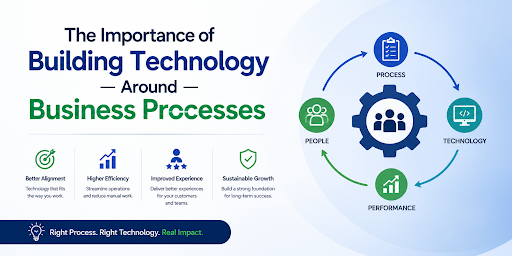
This is the heart of a mistake I spend a great deal of my time helping businesses avoid. Technology should be built around your processes. Your processes should not be bent to fit someone else’s technology. When that order gets reversed, the business pays for it slowly and continuously, long after the initial excitement of the purchase has faded.
When a process is well understood and genuinely worth keeping, thoughtful custom software development services let you encode that process into a tool that fits like a tailored suit rather than something bought off the rack and pinned at the seams. The value is not the software itself. The value is that the software finally reflects how your business actually creates value.
The same principle extends to the field, the warehouse, the sales floor, and anywhere work happens away from a desk. Well-designed custom mobile application development services matter most when they mirror the real sequence of steps a person takes during their day, rather than forcing that person to adapt their movements to a rigid screen. Mobile done right removes friction. Mobile done wrong simply relocates it.
Process First, Technology Second
The instinct to lead with technology is understandable. Software feels concrete. You can see it, demo it, and put a price on it. Processes feel softer and harder to pin down, so they get skipped or assumed.
But a business is, at its core, a collection of processes. How you take an order. How you onboard a customer. How a problem gets escalated and resolved. How money moves and how decisions get made. The technology is only ever a tool for executing those processes more reliably, more quickly, or at greater scale.
When I begin working with a client, I rarely start with the software question. I start by asking how the work actually flows today, where it slows down, and where the friction lives. That conversation almost always reveals something the leadership did not fully see, because the people doing the work have adapted around the broken parts so quietly that the cracks became invisible.
Only once that picture is clear does the technology question become worth answering. By then the answer is usually obvious, because the right tool reveals itself once you understand the job it has to do.
The Hidden Cost of Technology-First Thinking
When software is chosen before the process is understood, the costs show up in predictable places, and most of them never appear on the original invoice.
The first is shelfware, meaning software that was purchased, paid for, and barely used. Teams revert to old habits because the new tool does not fit their reality, and the investment quietly evaporates.
The second is the rise of workarounds. People are resourceful, and when a system does not match their work, they build bridges around it. Those bridges are usually undocumented, fragile, and dependent on a few individuals who remember how the unofficial process really works. The moment those people leave, the knowledge leaves with them.
The third is shadow technology, where departments start adopting their own unsanctioned tools because the official system does not serve them. This fragments data, creates security gaps, and makes it nearly impossible to get a single trustworthy view of the business.
None of these costs are dramatic on any given day. That is exactly why they are dangerous. They accumulate slowly, and by the time leadership notices, the organization is spending real money to maintain a system that is actively working against it.
Mapping the Process Before Building Anything
The discipline that prevents all of this is simple to describe and harder to practice. You map the process before you build or buy.
Mapping does not mean producing a beautiful diagram that lives in a slide deck. It means sitting with the people who do the work and tracing the real sequence of steps, including the messy parts, the exceptions, and the moments where someone has to make a judgment call. The exceptions matter enormously, because in most businesses the exceptions are where the difficulty and the cost actually live.
A good process map answers a few honest questions. What triggers this work to begin? What are the steps, in the order they truly happen rather than the order the policy manual claims? Where does work wait, and why? Where do errors creep in? What information does each step need, and where does that information come from?
When those answers are on the table, the technology decision becomes clearer and far less risky. You can see exactly which steps should be automated, which should be supported by a tool, and which should be left to human judgment. You can also see which parts of your process are genuinely distinctive and worth preserving, and which are simply habits that no longer serve anyone.
Where Custom Software Earns Its Place
I am not an advocate for building everything from scratch. Off-the-shelf software is often the right answer, especially for functions that are standard across industries, such as accounting, payroll, or email. There is little advantage in reinventing tools that thousands of businesses already use well.
The case for custom software becomes compelling when a process is core to how your business competes and does not match what generic tools assume. If the way you fulfill orders, price your work, or serve your customers is part of what makes you better than your competitors, then forcing that process into a one-size-fits-all tool can quietly erode the very thing that sets you apart.
The judgment I help clients make is this. Standardize where you are ordinary, and build around the places where you are distinctive. Spending a custom development budget on commodity functions is waste. Spending it on the processes that define your edge is one of the highest-return investments a business can make.
When the Work Happens Away From the Desk
A large share of real business work does not happen in front of a computer. It happens in vehicles, on shop floors, in client offices, and out in the field. This is where mobile technology becomes essential, and where the process-first principle matters even more.
A field technician does not want to navigate seven screens to log a completed job. A salesperson does not want to retype notes into a system at the end of a long day. When mobile tools are built around the actual rhythm of the work, they capture information at the moment it is created, which is when that information is most accurate and least burdensome to record.
The failures I see in mobile almost always come from designing the screen before understanding the situation. A form that makes sense at a desk can be unusable in gloves, in poor light, or with one hand while holding equipment. Building around the process means observing how the work really happens and shaping the tool to that reality, not the other way around.
The Automation and AI Dimension
Much of my work today involves intelligent automation, and the process-first principle is even more important here than elsewhere. There is a strong temptation to apply automation or artificial intelligence to a process simply because it is technically possible.
But automating a broken process only makes you produce bad outcomes faster. Before you automate anything, you should understand the process well enough to know which parts genuinely benefit from automation, which need human oversight, and which should be redesigned entirely before a single line of automation is written.
The businesses that succeed with AI are not the ones that adopt it earliest. They are the ones that understood their processes well enough to apply it precisely. Clean processes produce clean data, and clean data is what makes automation and AI reliable rather than risky. The work you do to understand your processes today is the same work that makes you ready for intelligent technology tomorrow.
A Practical Example
A distribution company I advised had invested heavily in a well-regarded inventory platform, yet their stock counts were perpetually wrong and their staff distrusted the system. Leadership assumed they needed a better platform.
When we traced the actual process, the issue became clear within a day. The software assumed inventory was counted in one motion at one location. In reality, their goods moved through three handoffs across two buildings, and the system had no concept of that middle ground. So staff guessed, corrected later, and lost faith in the numbers.
We did not replace the platform. We built a lightweight custom layer, including a simple mobile tool, that matched their three-stage reality and fed clean data back into the system they already owned. Within a quarter, stock accuracy rose dramatically, the manual reconciliation work nearly disappeared, and the staff began trusting the data enough to act on it. The technology had not been the problem. The mismatch between the technology and the process had been the problem all along.
The Long View
The most durable technology investments I have seen all share one quality. They were shaped by a genuine understanding of how the business works, rather than by an assumption imported from a vendor or a competitor.
My advice to the leaders I work with is consistent. Resist the urge to lead with the tool. Lead with the process, understand it honestly including its messy edges, and let that understanding guide every technology decision that follows. Standardize where you are ordinary, build where you are distinctive, and never automate a process you have not first taken the time to understand.
In my experience, technology built around the business tends to last for years and quietly compounds in value. Technology that forces the business to bend around it tends to become the next expensive thing someone is hired to replace.