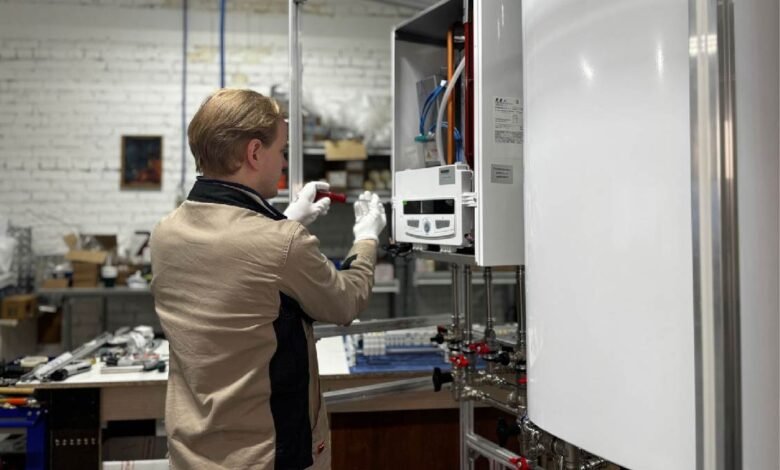
Plate heat exchangers are among the most important components in modern heating and heat pump systems – yet they’re often overlooked in favour of the more visible parts of an installation. A poorly specified or undersized exchanger limits system performance regardless of how good the boiler or heat pump is; a well-chosen one improves efficiency, protects the wider system and reduces long-term maintenance costs. Understanding how they work and what to look for when specifying one makes a real difference to installation outcomes.
Heat transfer is at the heart of every heating and cooling system – and the component responsible for making that transfer happen efficiently is the heat exchanger. In modern installations, plate heat exchangers for heat pump systems are the preferred choice for their compact size, high thermal efficiency and durability. Culm Stores supplies INOX (stainless steel) plate heat exchangers suited to a range of domestic and commercial applications – but before getting into selection, it’s worth understanding what a plate heat exchanger actually does and why its design matters.
What is a plate heat exchanger?
A plate heat exchanger (PHE) is a device that transfers heat between two fluid streams without allowing them to mix. It consists of a series of thin, corrugated metal plates clamped together in a frame or brazed into a single unit. Each plate has inlet and outlet ports at its corners, and the plates are arranged so that the two fluid streams flow through alternating channels – one fluid on one side of each plate, the other fluid on the other side. Heat passes through the plate material from the hotter fluid to the cooler one, while the fluids themselves remain completely separate.
The corrugated surface of each plate serves two purposes: it increases the surface area available for heat transfer, and it creates turbulence in the fluid flow, which improves the rate at which heat moves from one stream to the other. The result is a highly efficient heat transfer device in a remarkably compact form factor.
How plate heat exchangers work – the counter-flow principle
Most plate heat exchangers are arranged so that the two fluid streams flow in opposite directions – a configuration known as counter-flow. This arrangement maximises the temperature difference between the two streams across the full length of the exchanger, which in turn maximises heat transfer efficiency. In a counter-flow arrangement, the coolest incoming fluid meets the coolest outgoing fluid at one end of the exchanger, and the hottest incoming fluid meets the hottest outgoing fluid at the other end. This produces a more consistent and efficient heat transfer profile than parallel-flow arrangements, where both streams enter at the same end and the temperature difference diminishes along the length of the exchanger.
In practice, this means a well-designed plate heat exchanger can achieve very close approach temperatures – the difference between the outlet temperature of one fluid and the inlet temperature of the other can be as small as 1-2°C in high-performance units. That level of efficiency is difficult to achieve with shell-and-tube or other heat exchanger types at the same physical size.
Why plate heat exchangers matter in heat pump systems
Heat pumps transfer heat rather than generating it directly, which makes the efficiency of every heat transfer step in the circuit critical to overall system performance. A heat pump’s coefficient of performance (COP) – the ratio of heat output to electrical energy input – depends significantly on how well heat is transferred at each stage of the refrigerant cycle.
In a typical heat pump installation, a plate heat exchanger sits between the refrigerant circuit and the heating water circuit. The refrigerant gives up heat to the heating water across the plate exchanger; the quality of that heat transfer directly affects the temperature at which the refrigerant condenses and, consequently, the COP of the entire system. A high-efficiency plate heat exchanger with a small approach temperature allows the heat pump to operate at a lower condensing temperature for a given flow temperature – which improves COP and reduces electricity consumption.
That relationship between heat exchanger performance and heat pump efficiency is why specifying a quality exchanger matters. A cheaper, less efficient unit may reduce upfront cost but will cost more to run over the lifetime of the installation.
Applications beyond heat pumps
Plate heat exchangers are used across a wide range of heating and cooling applications:
- Heat pump systems: primary to secondary circuit separation, refrigerant-to-water heat transfer.
- District heating connections: isolating a building’s internal circuit from the district heating network, allowing independent pressure and water quality management.
- Domestic hot water production: heating potable water from a heating circuit without mixing the two water streams.
- Industrial process heating and cooling: transferring heat between process fluids in manufacturing and food processing.
- Chilled water systems: cooling water circuits in commercial HVAC installations.
- Solar thermal systems: transferring heat from collector fluid to storage or distribution circuits.
In each application, the same fundamental principle applies: efficient heat transfer between two fluid streams in a compact, cleanable or replaceable unit.
Why stainless steel (INOX) is the preferred material
The material from which the plates are made has a significant effect on durability, corrosion resistance and compatibility with different fluids. Stainless steel – referred to as INOX in the European specification – is the most widely specified material for plate heat exchangers in heating and heat pump applications, and for good reason.
Stainless steel offers:
- Corrosion resistance: suitable for use with treated heating water, glycol-water mixtures (common in heat pump circuits) and a range of industrial fluids.
- Longevity: stainless steel plates resist the pitting and general corrosion that can affect copper or carbon steel alternatives, particularly in systems with variable water chemistry.
- Thermal conductivity: while not as thermally conductive as copper, stainless steel’s conductivity is more than adequate for plate heat exchanger applications, where the corrugated geometry and thin plate construction compensate effectively.
- Compatibility: suitable for use with the refrigerants and glycol mixtures common in heat pump circuits, without the compatibility concerns that affect some other materials.
For commercial and industrial applications where longevity and reliability are priorities, INOX plate heat exchangers represent the sensible specification choice.
Brazed vs gasketed plate heat exchangers
Two main construction types are used in heating and heat pump applications:
- Brazed plate heat exchangers (BPHEs): the plates are permanently joined using a brazing material – typically copper or nickel – creating a compact, leak-resistant unit with no gaskets to replace. BPHEs are well suited to refrigerant applications and smaller heating circuits where the unit is unlikely to need disassembly for cleaning.
- Gasketed plate heat exchangers: the plates are held together by a frame and bolts, with rubber gaskets sealing between plates. These can be disassembled for mechanical cleaning and the plate count can be adjusted to change capacity. Better suited to larger installations or applications where fouling is a concern and regular cleaning is anticipated.
For most heat pump and domestic heating applications, brazed units are the practical choice – compact, reliable and cost-effective. Larger commercial and district heating applications often benefit from the serviceability of gasketed units.
Selection criteria: what to specify
When selecting a plate heat exchanger for a heating or heat pump application, the key parameters are:
- Thermal duty: the required heat transfer rate in kW – must match the system’s peak demand.
- Flow rates: primary and secondary flow rates in litres per minute or cubic metres per hour.
- Inlet and outlet temperatures: for both primary and secondary streams; these determine the required approach temperature and influence plate count.
- Working pressure: confirm the exchanger’s rated pressure exceeds the maximum system pressure on both sides.
- Fluid compatibility: confirm plate and brazing material compatibility with the fluids involved – particularly important for refrigerant circuits and systems using inhibitors or glycol.
- Connection sizes: match to existing pipework to avoid improvised reducers.
Getting these parameters right at the specification stage avoids the common problem of undersized exchangers that limit system performance or oversized units that add unnecessary cost.
Maintenance and fouling
Plate heat exchangers are generally low-maintenance components, but they are not immune to fouling. Scale deposits from hard water, biofilm growth in low-temperature circuits and particulate contamination can all reduce heat transfer efficiency over time. The best protection is clean system water – maintained through appropriate filtration, inhibitor dosing and, in hard water areas, scale prevention. For gasketed units, periodic mechanical cleaning is straightforward; for brazed units, chemical cleaning is the standard approach when fouling is suspected.
Signs of fouling include rising flow temperatures needed to achieve the same output, increased pressure drop across the exchanger and, in severe cases, reduced flow rates. If you notice any of these symptoms, a chemical clean or unit replacement may be warranted before the problem affects the wider system.
Common questions
Do I need a plate heat exchanger if my heat pump already has an internal heat exchanger?
Many heat pumps include an internal heat exchanger as part of the refrigerant circuit. An external plate heat exchanger is typically used to separate the refrigerant circuit from the heating water circuit – providing hydraulic separation, allowing different water quality standards on each side and protecting the heat pump from system contamination.
How do I know if my plate heat exchanger is fouled?
Rising flow temperatures required to achieve the same heat output, increased pressure drop across the unit and reduced flow rates are the most common indicators. A chemical clean or inspection is warranted if any of these symptoms appear.
Can a plate heat exchanger be used with glycol mixtures?
Yes – stainless steel plate heat exchangers are compatible with glycol-water mixtures commonly used in heat pump and solar thermal circuits. Confirm the brazing material compatibility with the specific glycol concentration used.