Introduction:
Clicking the Sound No One Wants to Hear Repeated on your hard drive is one of the most alarming noises a computer can make. It usually means that something went wrong within the drive, and the files you trust might be in danger.
Many people panic and start trying out fixes at once, but the smartest thing is to figure out the problem first. There are professional data recovery services for clicking hard drive UK, and acting in the first few minutes appropriately can determine if your files survive for that particular situation.
What This Guide Explains
you will learn why drives click, what to do and avoid, immediately, and how the recovery process functions. We also tell you how to select a reliable UK provider, to help you know if the drive contains personal memories or important business data.
Why Hard Drives Click
Clicking often occurs when the head cannot find the data it needs, tries over and over and resets. Common causes include damaged components or misaligned heads, wear, firmware corruption and physical impacts that are caused by fall or shock. So that turns out to be a drive, which might spin, click, and then disappear from a computer.
Because this is typically a mechanical defect, data recovery specialists for clicking hard drives in the UK handle this in a completely different fashion to simple software problems such as accidental removal.
Warning Signs Before the Clicking Starts
Slow access to files, frequent freeze, unexplainable crashes, and files that do not open frequently appear in advance. If you notice such signs, immediately back up your most important data and stop using the drive. Catching the problem early can save you from the need for recovery at all.
What to Do Straight Away
With each click, the head is susceptible to scratches or being overcome and continuation of the operation may cause permanent damage to a plate. Remove the drive, put it in an anti-static bag or padded box, and avoid moving it unnecessarily.
Make a note of when clicking started and any error messages that you saw, as this information helps engineers diagnose the error faster. Then, contact a professional instead of trying any additional tests yourself.
Common Mistakes to Avoid
Running recovery software on a drive click makes the failing head work harder. Inserting a drive into a freezer is a myth, which may lead to condensation and corrosion.
Taking it or shaking it, exchanging the circuit board with no experience, or opening the casing inside the house exposes the platters to dust and can make recovery impossible. If your data are valuable, do leave all these experiments alone.
How Professional Recovery Works
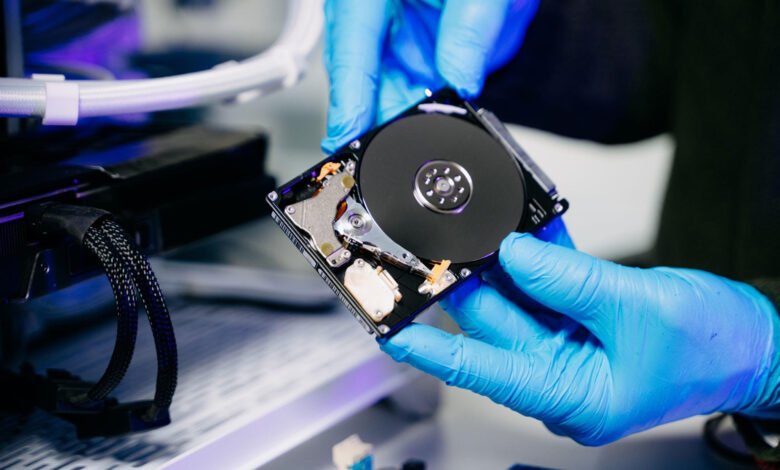
How Professional Recovery Works A serious lab begins with a first diagnostic evaluation to identify the exact fault. When the head is damaged, engineers open up the drive in a controlled cleanroom and replace it with compatible donor parts.
Then, they connect the drive to specialized imaging equipment that gently reads the data, working around defective sectors rather than forcing them into it. The recovered data are copied to a new device, so that there have never been unnecessary restrictions on the original drive.
Can Every Clicking Drive Be Fixed?
Not always, but it’s possible to be many. Success depends on if the platters are intact and how much the drive has been used after clicking on it. The quick-rolled drives often work better than the running drive away for days.
Even if full restoration is not possible, specialists have often had access to the most important files. Therefore a professional assessment deserves to be called up before the driver can be removed.
What Affects Success and Cost
Success rates and prices vary depending on the kind of damage, capacity of the drive and the speed at which you need the files. The heavily damaged platters are more difficult to recover than a failed head alone.
Standard turnaround takes longer than priority services and has higher priority services fees. No provider can honestly guarantee an outcome before assessing the drive, so be careful with unrealistic promises and always ask for a written quote.
Choosing a Trusted UK Provider
Read the independent client review and ask whether providers have experience with your specific drive brand and mistakes. Confidentiality issues, particularly for business data, so see how to handle and remove your files after recovery.
A reliable provider will explain the process in plain language and will never pressure you to make a quick decision.
Clicking Drives in Business Settings
Tell your IT team right away, keep the drive switched off and ask providers about privacy and emergency envelopment practices.
After that check your backup policy and document the incident so that your team cannot interfere with the same failure. Organised and timely actions limit both downtime and financial consequences.
Preventing Future Data Loss
Avoiding Future Data Loss Once your files are safe, set up a good backup routine. Follow rule 3-2-1: Keep three copies of your data in two different ways in a cloud or on a secure external basis.
Replace aging drives before they break down and treat unusual noises as early warning instead of ignoring anything.
Conclusion
Act Fast, Stay Calm
A clicking hard drive is serious, but there is no need for constant loss. Turn off the drive, resist DIY repairs and get in touch with a trained specialist that can properly assess the damage.
Choosing correct data recovery for clicking hard drive UK means that you often can safely get your files back. Remember that speed, caution and expert assistance provide the best chance of success for you.