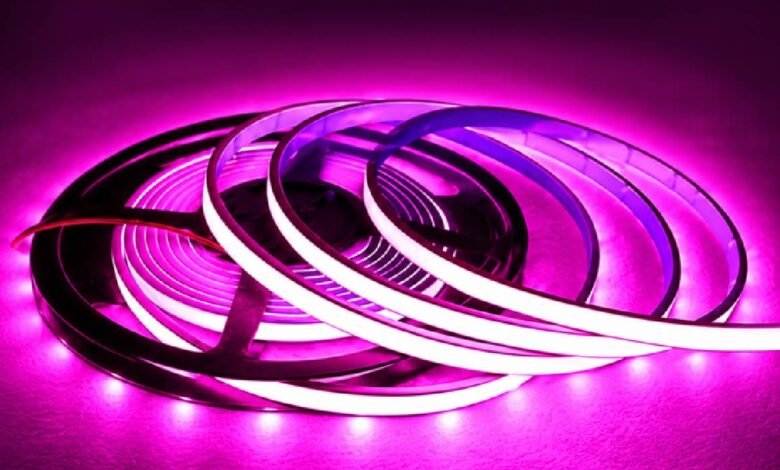
Lighting plays an important role in how customers, employees, and visitors experience a commercial environment. From retail stores and restaurants to offices and hotels, the right lighting can improve visibility, highlight architectural details, and create a more welcoming atmosphere. LED strip lights have become a popular option because they offer flexible installation and can be used in many different areas.
When planning a commercial lighting project, choosing suitable commercial LED strip lighting requires more than simply selecting a bright light. Businesses should consider the application, required lighting effect, installation conditions, and compatibility with other electrical components.
Why LED Strip Lighting Works Well in Commercial Spaces
Commercial environments often require lighting in areas where traditional fixtures are difficult to install. LED strips provide a flexible solution for shelves, ceilings, display units, staircases, and decorative architectural features.
Their slim design makes them suitable for concealed installations, including ceiling coves, furniture edges, and display cabinets. They can also be used to create continuous lines of light along selected surfaces.
Another advantage is the variety of LED strip options available. Different strip designs can support different purposes, from general illumination to colorful decorative effects.
Common Applications in Business Environments
Retail Stores and Product Displays
Retail lighting can influence how customers notice products and move through a store. LED strips installed inside shelves, display cabinets, and counters can highlight merchandise without taking up much space.
RGB LED strips can also introduce colorful decorative effects, making them useful for selected displays and promotional areas. For businesses that prefer a clean appearance, white LED strips can provide a more subtle lighting effect.
Offices and Commercial Buildings
In offices, lighting should support a comfortable and practical working environment. LED strips can be installed in ceiling coves, corridors, reception areas, and other architectural features.
They can also complement existing lighting fixtures by adding indirect illumination and highlighting specific parts of the interior.
Hotels, Restaurants, and Hospitality Spaces
Hotels and restaurants often use lighting to establish a particular atmosphere. Warm lighting around ceilings, staircases, furniture, and architectural details can help create a welcoming environment.
LED strips are also suitable for decorative applications in cafés, lounges, and entertainment spaces where lighting contributes to the overall interior design.
Outdoor Areas and Building Features
Commercial properties may use LED lighting around building outlines, pathways, signage, and landscape features. For these installations, the environmental conditions should be considered carefully.
Waterproof LED strip options are available for applications that require additional protection against moisture. The appropriate protection level should be selected according to the actual installation environment.
Understanding Different LED Strip Options
Not every LED strip is designed for the same lighting purpose. Understanding the available types makes it easier to select a suitable product.
2835 LED strips are commonly presented as an option for general lighting in rooms, shelves, and ceiling coves. Their suitability depends on the required brightness and installation design.
5050 RGB LED strips are useful when a project requires colorful lighting for decoration, events, and entertainment environments.
High-density 2835 LED strips can provide a more continuous and uniform appearance, which may be useful where visible individual light points are undesirable.
3014 LED strips have an ultra-slim design that can work well in narrow spaces and detailed lighting installations.
Silicone neon LED strips offer a flexible neon-style appearance for signs, building façades, and decorative applications.
Selecting the right type depends on the visual result, available installation space, and technical requirements of the project.
The Importance of a Suitable Power Supply
A reliable power supply is an important part of any LED strip installation. Even a suitable LED strip may not perform as expected if its power source is incorrectly selected.
Before installation, buyers should check the strip’s input voltage and power requirements. The power supply must be compatible with the selected LED product and should be chosen with the complete installation in mind.
Stable electrical output is also important. An unsuitable or unstable power source can contribute to flickering, overheating, and reduced component life.
For outdoor or moisture-prone installations, the power supply enclosure and protection rating should also be appropriate for the environment. Proper connections and installation practices help support safe operation.
What to Look for in an LED Strip Supplier
Choosing an experienced LED strip lights supplier can make the purchasing process easier, particularly for businesses handling multiple commercial projects.
Consider the following points before placing an order:
Product variety: Check whether the supplier offers different LED strip types for general, decorative, waterproof, and architectural applications.
Technical information: Request clear details about voltage, power consumption, dimensions, and available protection ratings.
Quality control: Ask about the supplier’s quality inspection procedures and product consistency.
Customization: If the project has specific requirements, check whether OEM and ODM services are available.
Technical support: A supplier that can provide product guidance can help buyers make more informed decisions.
Delivery arrangements: Confirm production schedules, packaging, and shipping details before finalizing a bulk purchase.
Comparing suppliers on these factors can help businesses avoid selecting products based only on their initial price.
Planning a Commercial LED Lighting Project
Before purchasing LED strips, prepare a basic lighting plan. Identify the areas that need illumination and decide whether the goal is general lighting, accent lighting, signage, or decoration.
Measure the installation areas and confirm the required strip length. Next, select the appropriate LED type and check its electrical specifications. If the project includes outdoor locations, verify the waterproofing requirements.
It is also useful to test a sample before ordering large quantities. A sample allows the project team to evaluate the actual appearance, brightness, and compatibility with the planned installation.
For larger projects, discussing technical requirements with the supplier in advance can reduce unnecessary changes during installation.
Final Thoughts
LED strip lighting offers businesses a flexible way to improve commercial interiors, highlight displays, and add decorative details to buildings. However, successful results depend on choosing the right strip type, compatible power supply, and suitable protection for the installation environment.
By evaluating technical requirements and working with a supplier that offers product variety, quality control, and customization support, businesses can make more confident decisions for their commercial lighting projects.