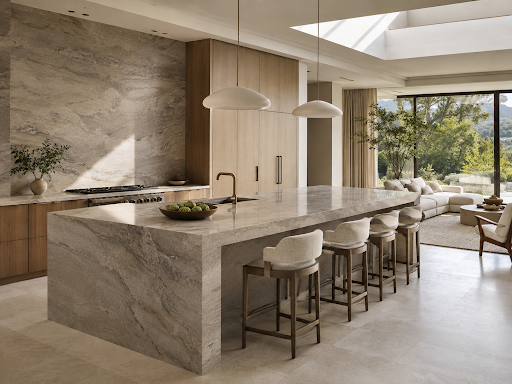
Luxury interior design is changing. Instead of relying on obvious displays of wealth, many contemporary homes now create a premium atmosphere through proportion, craftsmanship, natural materials, subtle texture, and carefully controlled details. This approach is often described as “quiet luxury”: a style that feels expensive without needing to announce itself.
Natural stone fits this design philosophy particularly well. Every slab carries variations in color, veining, mineral movement, and texture that cannot be perfectly reproduced by mass-manufactured decorative materials. Marble can bring softness and classical elegance to an interior, while quartzite can introduce dramatic movement and visual depth. Travertine, limestone, and granite can create entirely different moods depending on the architecture and application.
However, simply adding an expensive stone surface does not automatically make a room luxurious. Material selection, finish, slab scale, color coordination, installation details, and the relationship between stone and surrounding materials all influence the final result.
For homeowners, designers, and property developers, the real question is therefore not “Which stone looks most expensive?” but “Which stone creates the right atmosphere for this particular space?”
What Does Quiet Luxury Mean in Interior Design?
Quiet luxury focuses on quality that becomes more noticeable the longer someone experiences a space.
Instead of filling a room with decorative features, the design usually depends on a smaller number of carefully chosen materials. Natural wood, stone, metal, linen, leather, plaster, and textured fabrics can work together to create depth without visual clutter.
Several characteristics commonly define this approach:
- Neutral or restrained color palettes
- Natural materials with visible texture
- Large, uncluttered surfaces
- Clean architectural lines
- High-quality craftsmanship
- Subtle rather than excessive decoration
- Materials designed to age gracefully
Natural stone supports many of these principles because the material itself can become part of the decoration.
A marble wall does not necessarily need additional artwork. A carefully selected quartzite island can become the visual center of a kitchen. A limestone floor can connect several rooms without adding another strong design element.
The luxury comes from material presence rather than decoration.
Why Natural Stone Works So Well in Contemporary Luxury Homes
Stone combines three qualities that are particularly valuable in high-end interior design: authenticity, variation, and permanence.
Manufactured surfaces are often designed to achieve consistency. Natural stone does the opposite. Small differences between slabs are expected because each block developed through geological processes rather than an industrial printing process.
That variation can make a finished interior feel more individual.
Two kitchens may follow almost identical layouts, but using different stone slabs can completely change their character. One may appear calm and architectural, while another feels expressive and artistic.
Natural Variation Creates Visual Depth
The strongest natural stones are rarely visually flat.
Their appeal may come from:
- soft directional veins
- cloud-like mineral movement
- crystalline areas
- contrasting color bands
- subtle tonal transitions
- fossils or geological markings
These details become especially effective across large surfaces.
Instead of using many small decorative pieces, contemporary designers can use one large slab or a carefully matched group of slabs to create a stronger but cleaner visual statement.
Stone Connects Modern and Timeless Design
Interior trends change quickly, but stone has been used in architecture for centuries.
That history gives natural stone an advantage in homes designed for longevity. A well-selected surface can work with minimalist, transitional, classical, Mediterranean, contemporary, or even industrial interiors.
The design around the material may change, but the material itself does not automatically become dated.
Marble: The Classic Choice for Understated Elegance
Marble remains one of the most recognizable materials associated with refined interiors, but quiet luxury usually uses it differently from highly decorative traditional spaces.
Instead of covering every surface in polished stone, designers may introduce marble selectively.
It can appear as:
- a bathroom vanity
- a fireplace surround
- a feature wall
- a console table
- a kitchen backsplash
- a staircase detail
- a sculptural basin
- a dining or coffee table
The key is restraint.
A large surface of carefully selected natural marble can often create more visual impact than several unrelated decorative materials competing in the same room.
White and light-grey marbles can support calm interiors, while darker stones can create stronger contrast. Green, brown, red, or dramatically veined varieties may work better as focal materials rather than continuous background surfaces.
Where Marble Works Best
Marble is particularly effective where appearance, tactility, and natural character are priorities.
Consider marble when:
- you want a timeless rather than highly trend-driven material;
- the surface will act as a visual feature;
- natural veining is part of the design concept;
- you are comfortable with appropriate stone care;
- the project values natural patina rather than perfect long-term uniformity.
Marble does require realistic expectations. Depending on the application and finish, it can be affected by acidic substances, staining, scratching, or etching.
That does not make marble a poor material. It simply means the stone should be selected according to lifestyle and application rather than appearance alone.
If a household expects a perfectly unchanged countertop despite heavy cooking, frequent spills, and limited maintenance, another surface may be more practical.
If character, natural aging, and classical beauty matter more, marble can be an excellent choice.
How Stone Color Influences the Feeling of a Room
Stone selection is often treated as a product decision, but color has a major architectural effect.
A surface occupying several square meters influences how the whole room feels.
White and Soft Grey Stone
Light stone can make interiors feel open, calm, and bright.
It works especially well with:
- white oak
- warm walnut
- cream cabinetry
- brushed metal finishes
- off-white walls
- soft grey textiles
However, a completely white room can become visually cold. Natural veining, timber, textured plaster, or warm lighting can prevent the space from feeling clinical.
Beige and Warm Neutral Stone
Warm neutrals can create a more relaxed atmosphere.
They work particularly well in homes influenced by Mediterranean, organic modern, resort, or contemporary minimalist design.
Instead of dramatic contrast, these interiors often rely on layers of similar tones.
Think cream stone, warm timber, linen upholstery, textured walls, and muted metal details.
Dark Stone
Black, charcoal, brown, and deep green stones create stronger visual weight.
They can work beautifully in:
- bars
- powder rooms
- fireplace walls
- kitchen islands
- entertainment spaces
- statement furniture
The mistake is assuming dark stone always creates luxury.
If the surrounding room is already visually heavy, another dark material can make the space feel smaller or overly dramatic.
Dark stone is usually most successful when it has room to breathe.
Quartzite: When Quiet Luxury Needs More Visual Energy
Not every quiet luxury interior has to be pale, restrained, or almost monochrome.
Some of the most memorable contemporary homes use one dramatic natural material surrounded by very simple architecture.
Quartzite is particularly suitable for this approach.
Depending on the variety, quartzite can contain strong linear movement, clouds of color, crystalline areas, blue or green tones, gold accents, or dramatic contrasting veins.
It allows designers to create a focal surface without adding unnecessary decoration.
This is why premium quartzite can work particularly well for statement kitchen islands, feature walls, reception-style home bars, bathroom vanities, fireplace surrounds, and custom stone furniture.
Marble or Quartzite: Which Should You Choose?
The decision should begin with the project rather than the material name.
If classical softness and recognizable veining are the priority → consider marble.
If you want stronger visual movement with greater suitability for demanding countertop applications → consider quartzite.
If the surface is primarily decorative → appearance may carry more weight.
If it will receive heavy daily use → maintenance and physical performance should influence the decision more strongly.
This type of decision logic is far more useful than asking which stone is universally “better.”
There is no single best natural stone for every home.
Use Large Stone Surfaces Carefully
Large slabs can create one of the strongest quiet-luxury effects because they reduce visual interruption.
A full-height backsplash, large shower wall, waterfall island, or floor-to-ceiling fireplace can make the stone appear almost architectural.
But more stone is not always better.
When every surface becomes highly veined, the room can quickly move from refined to visually exhausting.
A better approach is often to establish a hierarchy.
- Choose one dominant stone surface.
- Keep surrounding finishes quieter.
- Repeat one or two colors from the stone elsewhere in the room.
- Avoid introducing multiple competing vein patterns.
- Use lighting to reveal texture instead of adding extra decoration.
If the kitchen island has very dramatic movement, the backsplash might be simpler.
If the bathroom feature wall is highly expressive, cabinetry and flooring can remain restrained.
Quiet luxury depends as much on what is removed as what is added.
Bookmatching Can Turn Stone Into Architectural Art
Some slabs contain directional patterns that can be mirrored during fabrication and installation.
This technique, commonly known as bookmatching, can create symmetrical compositions across large walls, fireplaces, shower panels, and other statement surfaces.
The result can be spectacular, but bookmatching should be intentional.
Strong symmetry becomes the focal point of a room. It therefore works best when surrounding elements remain simple.
Before fabrication, designers should review slab photographs or layouts and confirm:
- which slabs will be paired;
- where cuts will occur;
- how veins will continue across joints;
- where fixtures or openings will interrupt the pattern;
- how the installation will appear from the main viewing angle.
A beautiful slab can still produce a disappointing result if the layout is decided only after cutting begins.
For high-visibility applications, slab planning is part of the design process, not merely part of fabrication.
Finish Matters as Much as Stone Selection
Two pieces of the same stone can feel very different depending on the surface finish.
Polished Finish
Polishing increases reflectivity and usually makes color and veining appear stronger.
It is useful when the design calls for:
- formal elegance
- visual depth
- strong pattern definition
- a more reflective surface
However, polished stone can feel more formal than some contemporary interiors require.
Honed Finish
A honed surface has lower reflectivity and often produces a softer appearance.
This makes it particularly compatible with quiet-luxury interiors using timber, plaster, linen, and matte metals.
The reduced shine allows the material to feel substantial without becoming visually dominant.
Textured Finishes
Brushed, leathered, sandblasted, or other textured finishes can introduce tactile character.
They may be particularly useful on wall cladding, architectural surfaces, outdoor areas, or designs where texture matters more than reflection.
The correct finish should always be chosen according to both appearance and practical application.
Natural Stone Should Work With Other Materials
A luxury room rarely succeeds because of one expensive material.
What matters is the relationship between materials.
Stone becomes more convincing when paired thoughtfully.
Stone and Wood
Wood softens the hardness of stone.
Warm oak can balance cool white or grey marble, while walnut can complement cream, brown, green, or richly veined surfaces.
Stone and Metal
Metal details can change the character of the same stone.
Brushed brass may create warmth.
Blackened metal can make the room feel more architectural.
Stainless or chrome finishes can produce a cleaner contemporary effect.
Stone and Textiles
Natural fabrics prevent stone-heavy interiors from feeling cold.
Linen curtains, wool rugs, upholstered seating, and textured cushions create visual softness and improve balance.
Quiet luxury often comes from contrast between hard and soft materials rather than from using one premium material everywhere.
Common Mistakes When Designing With Natural Stone
Natural stone can elevate an interior, but poor decisions can make even expensive materials look ordinary.
1. Selecting Stone From a Small Sample Only
A small sample cannot always represent the movement of a full slab.
For strongly veined materials, reviewing the actual slab or a complete slab image is much safer.
2. Choosing Appearance Without Considering Use
A beautiful material may not suit every surface.
Kitchen countertops, shower walls, fireplace surrounds, floors, and decorative furniture all experience different conditions.
3. Using Too Many Statement Materials
A dramatic island, heavily patterned floor, decorative wall, bold cabinetry, and ornate lighting can compete rather than cooperate.
Choose a visual priority.
4. Ignoring Vein Direction
Direction matters on islands, waterfalls, wall panels, staircases, and large installations.
Poor vein alignment can make premium material look randomly assembled.
5. Forgetting That Natural Stone Varies
Natural variation is part of the material.
Expecting every slab to look identical defeats one of the main reasons for choosing natural stone in the first place.
A Simple Decision Framework for Choosing Stone
Before selecting a material, ask five questions.
- Where will the stone be installed?
A decorative wall and a hardworking kitchen countertop have different requirements. - How much visual movement should the room have?
Choose subtle stone for a calm background or dramatic stone for a focal feature. - How much maintenance is realistic?
Select according to the household’s actual habits rather than an idealized lifestyle. - What materials will surround the stone?
Cabinetry, flooring, wall color, metalwork, and lighting should be considered together. - Can the slab layout be reviewed before cutting?
For large-format installations, layout planning can dramatically improve the finished result.
This process helps move stone selection away from impulse and toward design compatibility.
Final Thoughts: Quiet Luxury Is About Restraint, Not Price
Natural stone can create an immediate sense of quality, but quiet luxury is not simply the result of choosing the most expensive slab.
The strongest interiors use stone deliberately.
Marble may provide timeless elegance. Quartzite may create a dramatic focal point. Travertine may bring warmth and texture. A neutral stone floor may quietly connect an entire home without becoming the center of attention.
The important principle is balance.
Choose materials because they support the architecture, lifestyle, and intended atmosphere of the space. Review full slabs rather than relying only on small samples. Think about finish, maintenance, vein direction, surrounding materials, and fabrication before making a final decision.
When these details are handled carefully, natural stone does something mass decoration often cannot: it gives a contemporary home individuality without making the interior feel overdesigned.
That is ultimately what quiet luxury is about—fewer materials, better choices, and details that become more rewarding the longer you live with them.
Frequently Asked Questions
1. Is natural stone good for luxury home interiors?
Yes. Natural stone is widely used in luxury interiors because every slab has unique color, veining, mineral movement, and texture. Marble, quartzite, granite, travertine, and other stones can be used for countertops, feature walls, bathrooms, fireplaces, flooring, stairs, and custom furniture. The best choice depends on the application, design style, expected maintenance, and level of daily use.
2. Is marble or quartzite better for kitchen countertops?
Neither material is automatically better for every kitchen. Marble is often chosen for its classical appearance and distinctive veining, but it requires greater awareness of staining and acid etching. Quartzite is frequently selected when homeowners want a natural stone with dramatic visual character and strong performance for countertop applications.
If appearance and natural patina are priorities, marble may be suitable. If durability under regular kitchen use is more important, quartzite may be the better direction.
3. What natural stone is best for a modern luxury home?
The best stone depends on the desired atmosphere. White or grey marble works well in calm, elegant interiors. Dramatic quartzite can create statement islands and feature walls. Travertine is suitable for warm, organic, Mediterranean, and resort-inspired spaces. Dark marble or granite can add contrast to bars, fireplaces, and powder rooms.
Rather than choosing by trend alone, match the stone to the room’s color palette, usage, and surrounding materials.
4. How do you choose natural stone for interior design?
Start with the application and practical requirements before choosing color. Review full slabs whenever possible, compare vein movement, decide whether the stone should act as a focal point or background material, consider the finish, and check how it works with cabinetry, flooring, metals, and lighting.
For large projects, slab layout and vein direction should also be planned before fabrication.
5. Does natural stone make a home look more expensive?
Natural stone can make an interior feel more refined, but the result depends on how it is used. One carefully selected stone feature often looks more sophisticated than covering every surface with expensive materials.
Large uninterrupted surfaces, good slab matching, clean fabrication, appropriate lighting, and restrained combinations usually create a stronger luxury effect than simply choosing the highest-priced stone.