Some songwriting starts with chords. Some starts with rhythm. But a surprising amount of modern music begins with language: a phrase that feels emotionally loaded, a hook that sounds unfinished but memorable, a verse that seems strong until someone tries to sing it. The problem is that lyrics on a page can hide structural weaknesses. They may look complete while still lacking lift, pacing, or sonic identity.
That is where a tool like ToMusic becomes genuinely useful. Its value is not only that it can produce music from text. The more practical contribution is that it gives lyric-driven ideas a fast way to become audible. When a writer hears words move through a generated arrangement, the song stops being theoretical. It becomes something that can be judged, revised, cut, or expanded.
For creators approaching the platform as an AI Music Generator, the first attraction may be speed. But for lyric writers, the deeper attraction is feedback. A generated song is not just an output. It is a mirror that shows where language works and where it breaks.
Why Lyrics Expose Weakness Faster Than Silence
A lyric draft often feels stronger in isolation than it does inside music. Repetition that reads as poetic may sound monotonous when sung. Lines that look emotionally sharp may become clumsy once rhythm is introduced. Chorus sections may not rise enough. Verses may carry too many syllables. These are not small issues. They define whether a song can hold attention.ToMusic’s lyrics-based route matters because it shortens the time between writing and hearing. That reduces guesswork and helps creators make better decisions earlier.
Why Hearing Changes Judgment
People edit differently when they are responding to sound rather than text. Once melody and arrangement enter the picture, weak lines become obvious. Strong lines also become clearer. In my observation, that immediate contrast is one of the most productive parts of AI-assisted songwriting.
Why Early Imperfection Still Helps
The generated result does not need to be flawless to be useful. Even a partially successful track can reveal pacing problems, emotional mismatches, or promising sections worth developing further.
How ToMusic Frames The Writing Experience
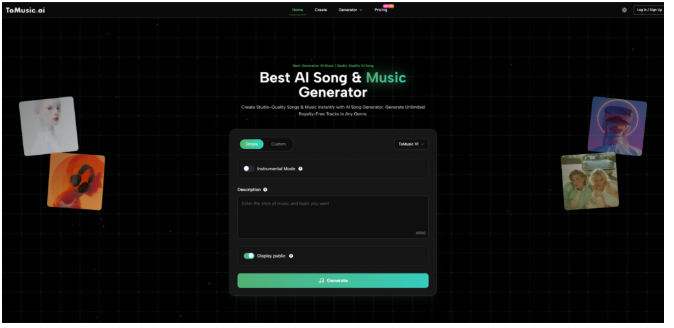
The platform allows users to start either with a descriptive prompt or with lyrics. For lyric-driven creators, the second path is the one that matters most. It takes existing words and places them into a structured musical context shaped by genre, mood, tempo, instrumentation, and vocal direction.
That design suggests an important philosophy. The platform is not asking every user to think like a producer. It is allowing writers to stay writers while still hearing a song begin to form.
What The Models Mean For Different Writing Goals
ToMusic includes four models, and this becomes especially relevant when lyrics are involved. Not every written piece needs the same kind of treatment.
| Writing Goal | Model Direction | What It Can Help Test |
| Fast lyrical draft check | V1 | Basic singability and flow |
| More atmospheric interpretation | V2 | Emotional texture |
| Stronger compositional movement | V3 | Harmonic and section contrast |
| More polished vocal emphasis | V4 | Delivery and realism |
This matters because a lyric can fail for different reasons. Sometimes the wording is weak. Sometimes the melody assignment is weak. Sometimes the emotional frame is wrong. Comparing models can help identify which issue is actually responsible.
How A Lyric Writer Can Use The Platform In Three Steps
The workflow is simple on the surface, but it becomes more effective when used with clear intent.
Step 1. Choose The Model And Paste The Lyrics
Start by selecting the model that best matches the writing goal. Then enter the lyrics you want the system to interpret musically.
Step 2. Add Style And Vocal Direction
Provide the musical frame: genre, mood, tempo, instrumentation, and vocal feel. These details help the system decide what kind of world the lyrics should live in.
Step 3. Generate And Revise Based On What You Hear
Listen critically. Does the chorus rise enough? Are the lines too dense? Does the emotional delivery match the words? The best next move is often revision, not acceptance.
Why The Prompt Around The Lyrics Still Matters
Some writers assume lyrics alone are enough. In practice, the surrounding guidance is often what determines whether the output lands in the right emotional register. The same lyric can feel intimate, theatrical, cinematic, understated, or radio-ready depending on how the musical frame is described.
Mood Changes Meaning
A melancholic arrangement can make a line feel reflective. A brighter arrangement can make the same line feel nostalgic or resilient. Musical framing is not decoration. It changes interpretation.
Tempo Changes Emotional Weight
Faster tempos can increase urgency but reduce lyrical clarity. Slower tempos can deepen emotional emphasis but also expose weaker lines. This is why generation is useful as a testing environment rather than just a production shortcut.
Why Hearing Generated Vocals Can Be So Useful
The phrase Lyrics to Music AI sounds technical, but its real significance is creative. It lets a writer hear how text behaves when it leaves the page and enters performance. That shift is especially valuable for people who do not sing or produce themselves but still want to evaluate whether their lyrics have musical potential.
Generated vocals can reveal whether a line has natural cadence, whether a chorus hook is memorable, or whether the emotional tone of the writing translates into sound. Even when the performance is not exactly what the writer wants, it gives them something concrete to react to.
Why This Helps Beyond Professional Songwriters
Indie creators, social content makers, and storytellers can also benefit from this process. Many people have lyric ideas without the technical background to score them. A lyrics-first tool lowers that barrier.
Why It Also Helps Experienced Writers
More experienced writers may use the platform differently. For them, the value may not be access but speed. Instead of waiting for a full demo session, they can audition structural ideas almost immediately.
What The Music Library Adds To A Writing Workflow
ToMusic saves generated pieces into a music library and keeps track of related metadata such as titles, descriptions, lyrics, and parameters. For lyric-driven work, this matters more than it may seem.
A writing process becomes messy when drafts scatter across notes apps, recordings, and memory. Saved generation history creates a more reviewable archive. Writers can compare versions, revisit earlier moods, and see which musical framing served the lyric best.
Why Archiving Supports Better Rewriting
Rewriting is easier when previous attempts remain accessible. A writer may realize that version three had the best chorus pacing while version five had the strongest emotional tone. Stored drafts make that comparison possible.
What Limits Should Be Acknowledged
No lyrics-based generator removes the need for taste. If the original writing is unclear, the output may still feel unfocused. If the prompt framing is weak, the song may miss the intended emotional target. And some results will simply need multiple tries before they become useful.
Why Iteration Is Not A Sign Of Failure
In lyric-centered work, iteration is part of the method. Hearing a draft, editing a line, changing the mood direction, and generating again is often how better songs emerge. The platform seems built for that loop rather than for one-shot certainty.
Why Human Judgment Remains Central
The tool can provide melodic and structural possibilities, but it cannot decide what a writer truly wants to say. The most important editorial decisions still belong to the person behind the lyrics.
Why That Division Feels Healthy
The platform becomes more credible when it is treated as a creative amplifier instead of an author. It can surface options, expose weak spots, and accelerate exploration. That is already meaningful.
Why This Workflow Feels Timely
Modern music creation has become less linear. Writers, producers, editors, and content creators often move between roles quickly. A platform that can turn lyrics into an audible draft fits that reality. It allows language-first creators to work sooner with musical feedback rather than waiting until later stages.
That is the real appeal of ToMusic for lyric writers. It does not remove the difficulty of songwriting. It makes the difficult parts easier to hear. And once a writer can hear what is wrong—or surprisingly right—the path forward becomes much clearer.