Pruning is one of the most common forms of tree work, but it is also one of the easiest to get wrong. A branch may appear inconvenient from the ground, yet removing it can change weight distribution, expose a large wound or trigger weak replacement growth. In compact London gardens, where trees often stand close to buildings, boundaries and paths, those consequences can affect both the tree and the property around it.
The purpose of pruning should therefore be defined before any cutting begins. Some trees need clearance from roofs or footpaths, some have damaged or crossing branches, and others have crowns that have become too dense for their setting. A good specification focuses on solving a specific problem while retaining as much healthy structure as possible.
Professional tree surgery London services are most useful when the person assessing the tree understands how different pruning methods affect future growth. Kettlewell Treecare describes work including crown reduction, thinning, lifting, pollarding, removals, rigging and planting across London and Essex. Those techniques are not interchangeable. The right choice depends on the tree, the site and the reason intervention is needed.
Pruning Should Preserve Structure
Healthy trees organise their crowns over many years. Main limbs carry secondary branches, smaller growth distributes foliage and the whole structure responds to light and wind. Randomly shortening branches can disturb that balance. Good pruning works with the existing form, removing or shortening selected growth rather than treating the canopy as a hedge.
Cut position matters as well. Correct cuts allow the tree to respond more effectively, while badly placed cuts can leave unnecessary stubs or damage the branch collar. Large wounds may take longer to compartmentalise and can expose internal wood. This is why experienced arborists consider both immediate appearance and the tree’s biological response.
Crown Reduction Is Not the Same as Topping
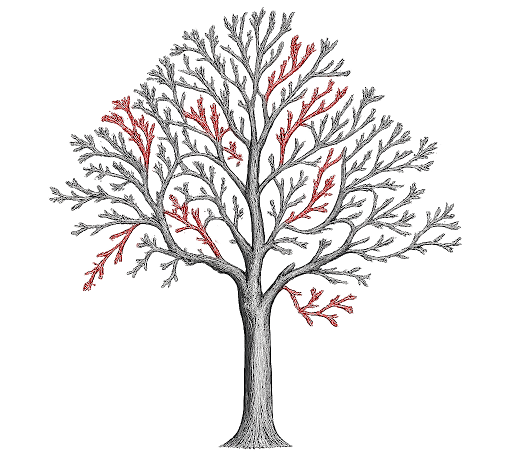
Crown reduction aims to reduce the overall size or spread of a canopy while maintaining a natural outline. Selected branches are shortened back to appropriate laterals so that the remaining growth can continue functioning. This can be useful where a mature tree has become too large for its surroundings or where branch weight needs to be reduced.
Topping is much more severe. Large limbs are cut back indiscriminately, often leaving a sparse framework and triggering vigorous shoots around the cut points. Those shoots can be poorly attached and may create future management problems. A carefully specified reduction avoids that cycle by limiting the amount removed and retaining suitable growth points.
Thinning Can Reduce Density Without Shrinking the Tree
Crown thinning selectively removes internal branches while keeping the overall height and spread broadly similar. The goal is usually to reduce density, improve air movement or lower wind resistance through the crown. Because the outer shape remains, thinning can be appropriate where a tree feels overly dense but does not need to be made significantly smaller.
Thinning also requires restraint. Removing too many internal branches can produce a lion-tailed appearance, with foliage concentrated at the ends of limbs. That changes how loads are carried and may increase movement at branch tips. Professional work distributes cuts across the canopy and keeps enough internal growth to preserve a balanced structure.
Crown Lifting Creates Clearance
Crown lifting deals with lower branches. It can improve access over paths and driveways, increase clearance around buildings or help maintain visibility near roads. In small gardens it may also allow more usable space beneath a tree without reducing the upper crown.
The challenge is deciding which lower branches can be removed without creating large wounds or an unbalanced stem. Mature trees with substantial low limbs may need a staged approach rather than aggressive removal in one visit. The final height of the crown should suit the surroundings while respecting the tree’s proportions.
Pollarding Is a Specific Management System
Pollarding is sometimes confused with heavy pruning, but it is a distinct method that relies on repeated management from established pollard points. When maintained correctly, new shoots are periodically removed from those points to control size and shape. It can be suitable for certain species and locations, especially where trees have already been managed this way for years.
Starting a pollard on an unsuitable mature tree can be a very different proposition. Species, age, previous pruning and the size of required cuts all matter. Homeowners should avoid assuming that pollarding is simply the strongest version of crown reduction. The method should be recommended for a clear arboricultural reason.
Urban Sites Make Pruning More Complex
London properties often provide limited working space. Branches may extend above conservatories, sheds, parked cars, neighbouring gardens or public paths. Even when the pruning itself is straightforward, getting cut material safely to the ground can require ropes, lowering systems and coordinated ground staff.
Access also affects how equipment is used and how waste is removed. A narrow side passage or terraced property may prevent large machinery from reaching the tree. Planning should account for the whole operation, from climbing and cutting to lowering, processing and final clean-up. That preparation reduces the temptation to improvise once work has started.
Timing and Tree Condition Matter
Not every pruning job should happen immediately. Species-specific biology, seasonal conditions, nesting wildlife, tree health and the urgency of the problem can influence timing. Dead or dangerous branches may require prompt attention, while routine formative work can sometimes be scheduled for a period that better supports the tree’s response.
An assessment should also distinguish between a pruning problem and a wider health or structural issue. Fungal fruiting bodies, cavities, major cracks, root disturbance or extensive dieback can change the risk picture. In those situations, simply cutting the visible branch may not address the underlying concern.
Ask for a Clear Specification
Before accepting a quote, property owners should understand exactly what is proposed. A useful specification might describe a percentage reduction, the intended clearance or the particular limbs to be removed. Vague wording such as ‘cut back tree’ leaves too much room for different interpretations and makes the finished result difficult to judge.
When discussing professional tree pruning, ask how the proposed work will affect the tree’s shape, why that method is being recommended and what the expected regrowth will be. A provider should be able to explain the reasoning in plain language. That conversation helps align the homeowner’s objective with an approach that protects the tree rather than simply removing the maximum amount of growth.
Good pruning is ultimately about control and foresight. The aim is to achieve safer clearance, better structure or a more suitable crown while preserving the tree’s ability to remain healthy in its setting. When cuts are planned around species, structure and site constraints, tree work can solve practical problems without sacrificing the long-term value a mature tree brings to a London property.