At the enterprise level, reputation isn’t just a marketing concern. It’s tied to valuation, partnerships, hiring, and long-term growth. One issue handled poorly doesn’t just create noise. It shows up in search results, investor conversations, and internal morale almost immediately.
That’s why the gap between good and great enterprise reputation management matters more than most companies realize.
On the surface, both can look similar. Monitoring tools are in place. Reviews are being answered. Reports are being shared. Everything appears under control.
But the difference shows up when something actually happens.
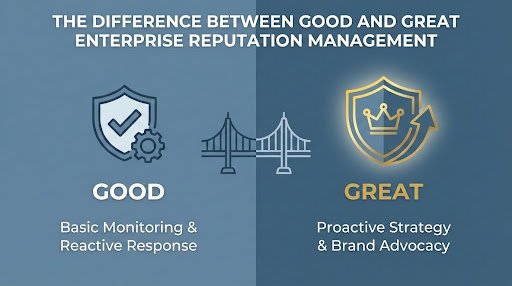
Good teams respond. Great teams don’t have to scramble in the first place.
Most Enterprise Programs Are Built to React
A lot of enterprise reputation management still runs on a reactive model.
You monitor brand mentions. You track reviews. You set up alerts. When something negative appears, the team steps in and handles it.
That works, to a point.
The problem is timing. By the time something is visible enough to trigger a response, it’s already moving. Internally, it might feel contained. Externally, it’s spreading across platforms, screenshots, and conversations you’re not even tracking yet.
That lag is where good programs fall short. They rely on visibility. And visibility always comes after impact.
Great Teams Operate Before the Problem Exists
The shift from good to great enterprise reputation management is really a shift in mindset.
Instead of asking, “How do we respond to this?” the question becomes, “Where is this likely to come from, and how do we get ahead of it?”
That changes everything.
You start looking at patterns instead of incidents. Sentiment trends instead of isolated mentions. Internal vulnerabilities instead of external complaints.
The work becomes less about reacting to reviews and more about understanding how perception is forming across channels.
And once you see it that way, you stop getting surprised.
Strategy Is Where the Gap Widens
A good program usually lives inside one team. Marketing, PR, maybe customer experience. They handle reputation as part of a broader function.
A great program doesn’t sit in one place. It’s built into the company’s operations.
Reputation becomes a shared metric across departments. Customer feedback loops into the product. Employee sentiment feeds into leadership decisions. Media perception ties into investor communications.
It’s no longer a side function. It’s infrastructure.
That’s the difference between managing reputation and actually shaping it.
Tools Don’t Define the Outcome, but They Expose It
Most enterprise teams have access to the same tool categories. Monitoring platforms, dashboards, sentiment analysis, and reporting systems.
The difference isn’t access. It’s how those tools are used.
In a good setup, dashboards are reviewed regularly. Alerts are acknowledged. Reports are distributed.
In a great setup, those same tools are used to predict movement.
You’re not just tracking what people are saying. You’re identifying how quickly sentiment is shifting, where it’s gaining traction, and what could trigger amplification.
That’s where enterprise reputation management shifts from observation to foresight.
AI Didn’t Close the Gap. It Made It More Obvious
AI has made reputation tools faster and more accessible. It can scan more sources, generate responses, and flag issues at scale.
But it also introduced a new problem. Over-reliance.
Good teams use AI to keep up with volume. Great teams use it to surface patterns, then apply human judgment where it matters.
Because context still matters. Tone still matters. Timing still matters.
Automation can support reputation. It can’t lead it.
And when companies treat it as a replacement rather than a tool, the cracks show quickly.
Crisis Response Is Where You See the Real Difference
This is usually the breaking point.
A good enterprise reputation management program has protocols. Response timelines. Pre-approved messaging. Legal review processes.
All of that is useful. Until the situation doesn’t fit the script.
Because most real issues don’t.
They evolve quickly. They cross channels. They involve multiple stakeholders at once. And they rarely give you time to move through a clean, linear process.
Great teams prepare differently.
They simulate scenarios. They pressure-test responses before they’re needed. They understand how decisions will play out across audiences, not just internally.
So when something does happen, they’re not figuring it out in real time. They’re executing.
That’s a completely different position to be in.
Reputation Isn’t Built in the Moment of Crisis
This is where many enterprise teams get it wrong.
They treat reputation as something that needs attention when there’s a problem.
In reality, the outcome of a crisis is usually decided long before it happens.
It’s shaped by how consistent your messaging has been. How much trust you’ve built. How quickly can your teams align? How familiar is your audience already with your brand voice?
If those pieces are strong, you have room to respond.
If they’re not, even a small issue can escalate.
That’s why great enterprise reputation management feels quieter most of the time. The work is happening in the background, long before anything goes public.
Where NetReputation Fits Into This Shift
At the enterprise level, execution matters as much as strategy.
Firms like NetReputation tend to stand out not because they offer more tools, but because they approach reputation as a system rather than a series of tasks.
That means looking beyond reviews and surface-level monitoring. It means understanding how search, media, and user-generated content interact. And it means building strategies that hold up over time, not just in the moment.
That kind of approach is what separates stabilization from actual control.
The Real Difference Comes Down to Control
That’s ultimately what this comes down to.
Good enterprise reputation management keeps things from getting worse.
Great enterprise reputation management gives you control over how your brand is perceived, even as things change.
One is reactive by design. The other is built to lead.
And in a landscape where information moves instantly and perception forms just as fast, that difference isn’t subtle.
It shows up in how quickly issues spread, how long they last, and how much they cost to fix.
More importantly, it shows up in whether you manage your reputation…
or something you actually own.