Oracle Recruiting Cloud can accept and store an uploaded resume as an attachment. What it doesn’t do natively is read that file and turn its contents into structured, standardized candidate profile fields, work history, education, skills, and certifications, ready for search, matching, and reporting. That gap is exactly what Enhanced Candidate Profile Import is built to close, and understanding it precisely is the difference between assuming Oracle already handles this and discovering the gap mid-implementation.
What Oracle Handles Natively
Out of the box, Oracle Recruiting Cloud is built to store candidate records and manage the application workflow: requisitions, application stages, approvals, and file attachments. A candidate can upload a resume, and Oracle will keep it attached to their record, viewable and downloadable by any recruiter with access to that requisition.
This is a genuinely solid foundation for workflow management. Oracle’s strength has always been orchestrating the recruiting process itself: routing candidates through stages, managing approvals, and keeping an auditable record of who did what and when. What Oracle doesn’t do on its own is convert an attached file into the structured data its own search, matching, and reporting tools need to function well. Without that conversion, the resume exists in the system, but its contents don’t, at least not in any form Oracle’s other tools can actually use.
Where the Gap Shows Up in Practice
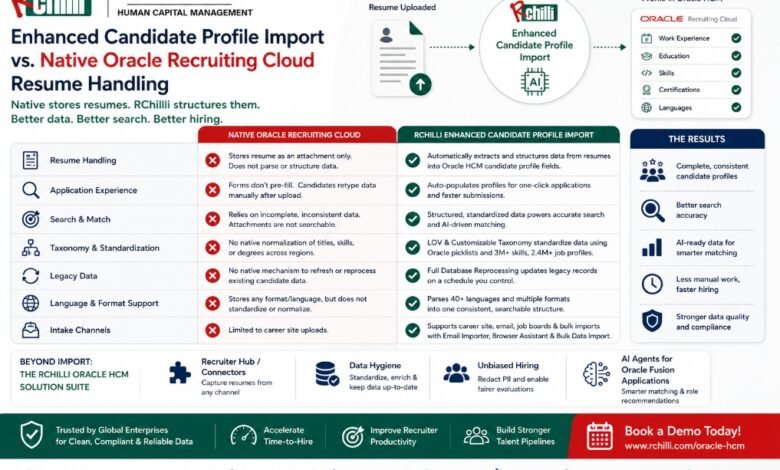
Application forms don’t pre-fill. Candidates still manually type work history and education even after uploading a resume containing that exact information, even though Enhanced Candidate Profile Import is built specifically to support one-click applications once profile data is auto-filled. Without that layer, the upload and the form are two disconnected steps rather than one continuous flow.
Search and match rely on incomplete data. Oracle’s search tools can only work with what’s in structured fields. A stored PDF attachment isn’t searchable the way a structured skills field is, which is why AI Agents for Oracle Fusion Applications depend on structured intake as a prerequisite, not an afterthought. A resume sitting as an unstructured attachment contributes nothing to search or matching, regardless of how qualified the candidate actually is.
No taxonomy normalization. Oracle doesn’t automatically reconcile “PM” and “Project Manager,” or map a UK degree to its US equivalent. That requires a dedicated List of Values and taxonomy layer sitting on top of the native platform, since reconciling terminology variants isn’t part of what Oracle’s core recruiting workflow was built to do.
No legacy data cleanup mechanism. Resumes attached to old candidate records stay exactly as outdated as the day they were uploaded, with no native mechanism to refresh them against current information. A candidate who uploaded a resume three years ago and has since changed roles, gained certifications, or relocated has a record that reflects none of that, unless something actively reprocesses it.
No multi-format, multi-language standardization. Oracle will store a resume regardless of format or language, but it won’t normalize a French-language resume and an English-language resume into the same searchable structure. Native attachment handling treats every uploaded file as an opaque object rather than a data source to be structured.
What Enhanced Candidate Profile Import Adds on Top
Enhanced Candidate Profile Import reads the uploaded resume and automatically builds a structured candidate profile inside Oracle HCM, populating personal details, work experience, education, skills, certifications, and languages across common file formats like PDF, DOCX, and HTML. This is the layer that turns “a file is attached” into “a usable candidate record exists,” and it’s the specific gap native Oracle attachment handling was never designed to close.
On top of that base capability, three additional layers address the specific gaps native Oracle leaves open, each solving a distinct piece of the problem rather than duplicating what Oracle already does well:
- List of Values (LOV) and Customizable Taxonomy standardize job titles, degrees, and skills against Oracle’s own picklists and a library of over 3 million skills and 2.4 million job profiles, solving the normalization gap native attachment handling leaves open entirely.
- Full Database Reprocessing refreshes existing candidate records on a schedule, so legacy attachments don’t stay permanently out of date the way they would under native handling alone.
- Bulk Data Import, Email Importer, and Browser Assistant extend structured intake beyond the career site application form, to email inboxes, job boards, and bulk migrations, none of which native Oracle attachment handling addresses at all.
Making the Build vs. Buy Decision
The honest framing of this decision isn’t Oracle versus a third-party tool. It’s workflow management, which Oracle already does well, versus data structuring, which Oracle was never built to do. Trying to build that structuring layer internally means replicating multi-format parsing, multi-language support, taxonomy mapping, and ongoing maintenance as language models and resume formats evolve, which is a substantial and ongoing engineering commitment rather than a one-time project.
Organizations weighing whether their existing manual profile creation process, rather than Oracle’s native attachment handling specifically, is good enough should look at what Enhanced Candidate Profile Import replaces end to end, and how it fits into the full RChilli Oracle HCM solution suite alongside data hygiene, unbiased hiring, and connector tools, rather than evaluating it as an isolated feature.
A Practical Test
If you’re unsure whether this gap actually affects your organization, try a simple test: pull ten resumes at random from your Oracle candidate database and check whether the skills, certifications, and full work history on the original resume are actually present as structured, searchable fields in the corresponding Oracle record. If most of that information exists only inside the attached file itself, rather than in fields a recruiter could search or filter on, that’s the gap Enhanced Candidate Profile Import closes.
FAQ
Does Oracle Recruiting Cloud parse resumes on its own? No. Oracle can store an uploaded resume as an attachment, but it doesn’t natively extract or structure the resume’s contents into candidate profile fields.
Do I need a third-party tool if Oracle already accepts resume uploads? If the goal is only file storage, no. If the goal is searchable, standardized candidate profiles that pre-fill applications and support accurate matching, a dedicated import and standardization layer is necessary, since Oracle doesn’t do that conversion natively.
What happens to resumes already attached to old Oracle candidate records? They stay as outdated as the day they were uploaded unless reprocessed. Full Database Reprocessing can refresh existing records against current resumes and taxonomy rules on a scheduled basis.
Is this a gap in Oracle Recruiting Cloud, or is it working as designed? It’s working as designed. Oracle’s core strength is workflow orchestration, not resume-to-structured-data conversion. The gap exists because that’s a distinct technical function that has to be added on top, not a flaw in what Oracle set out to build.
How can I tell if this gap is actually affecting my organization? Pull a sample of resumes from your Oracle database and check whether the full skills, certifications, and work history are present as searchable structured fields, rather than only existing inside the attached file itself.
See what Enhanced Candidate Profile Import adds on top of native Oracle resume handling, or explore the full RChilli Oracle HCM solution suite to see how it closes this gap end to end.