Are Aerosol Sprays and “All-Purpose” Solvents Quietly Destroying High-Speed Stitching Equipment?

In the modern world of convenience, we have been conditioned to believe in the universal “quick fix.” If a door hinge squeaks, a bicycle chain rattles, or a rusted bolt refuses to turn, the instinctual response is almost always the same: reach for a blue-and-yellow can of aerosol spray. These ubiquitous, all-purpose penetrating fluids are marketed as mechanical miracles, capable of silencing any squeak and loosening any jam.
Because of this intense marketing, many hobbyists, tailors, and even professional leatherworkers eventually carry this mindset over to their heavy-duty stitching equipment. When a cast-iron machine begins to sound slightly sluggish or a hand-wheel feels stiff, they aim the little red plastic straw into the oiling ports and give it a generous spray.
The machine instantly quiets down, the wheel turns freely, and the operator feels a sense of accomplishment. But beneath the cast-iron housing, out of sight, a catastrophic mechanical chain reaction has just been initiated. By treating a high-speed, precision-engineered piece of industrial equipment like a squeaky garden gate, operators are quietly and systematically destroying their own machinery.
The Anatomy of a Micro-Clearance
To understand why all-purpose sprays are so destructive, you must first understand the intense physical environment inside a commercial stitching machine.
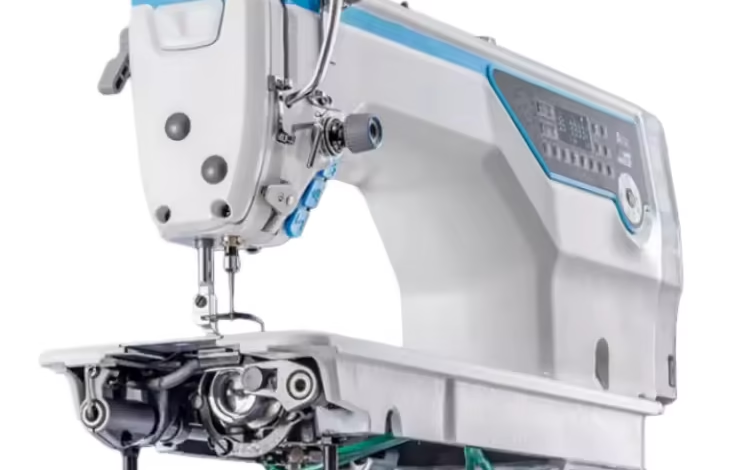
These machines are not simple mechanisms. They are complex assemblies of oscillating shafts, connecting rods, and spinning rotary hooks. When a machine is operating at a commercial speed of 2,000 to 3,000 stitches per minute, the internal metal components are moving with violent kinetic energy.
Despite this speed, the tolerances—the physical spaces between two moving metal parts—are microscopic. A high-end rotary hook is machined to clear the needle by a fraction of a millimeter. To survive this environment without welding itself together through sheer heat and friction, the machine relies on “hydrodynamic lubrication.” This means the moving parts do not actually touch; they ride on an invisible, microscopic film of fluid.
The Solvent Deception
The fatal flaw of using an all-purpose aerosol spray lies in a fundamental misunderstanding of chemistry.
The vast majority of these popular aerosol products are not actually lubricants at all. They are primarily solvents and water displacers (in fact, the most famous brand’s name literally stands for “Water Displacement”). Their chemical formulation is designed to be highly volatile. They are engineered to aggressively penetrate microscopic rust layers, break down oxidized metal, and evaporate moisture.
When you spray a solvent into the tight clearances of a precision machine, it does exactly what it was designed to do: it acts as an aggressive degreaser. It completely strips away whatever remaining protective oil film was coating the gears. For the first few minutes, the machine feels incredibly loose and fast because the solvent has thinned everything out.
However, because these sprays are largely composed of volatile organic compounds, they evaporate very quickly. Within a day or two, the liquid is gone. The metal components are now left completely bare, raw, and entirely unprotected against high-speed friction.
The Creation of “Grinding Paste”
The damage does not stop at evaporation. While the bulk of the aerosol solvent evaporates, it leaves behind a trace amount of heavy, waxy residue. In a door hinge, this residue is harmless. Inside a sewing machine, it is a death sentence.
The environment around a sewing machine is inherently dirty. Every time a needle punches through a layer of cotton canvas, denim, or vegetable-tanned leather, it kicks up a microscopic cloud of abrasive lint and fibrous dust.
When this airborne dust settles inside the machine, it mixes with the sticky, varnished residue left behind by the aerosol spray. Together, they form a thick, abrasive sludge. In mechanical engineering, this mixture is essentially a low-grade lapping compound—a literal grinding paste. As the machine runs, this paste is forced into the micro-clearances, acting like liquid sandpaper. It systematically grinds away the hardened steel of the rotary hook and the drive shafts.
Once a machine’s tolerances have been ground out by this abrasive paste, no amount of maintenance can save it. The machine will begin to skip stitches, snap threads, and lose its timing entirely. The only fix is a complete, wildly expensive mechanical rebuild.
The Physics of True Hydrodynamic Film
Protecting this machinery requires a fluid engineered specifically for the unique physics of the environment.
For decades, engineers have solved this problem by formulating highly refined, dedicated sewing machine lubricant that possesses the exact viscosity required to survive the assembly line. Unlike volatile aerosol solvents, these dedicated fluids are highly purified mineral oils. They are designed to be chemically inert, meaning they contain no aggressive detergents, rust dissolvers, or sticky varnishes.
More importantly, their viscosity—the measure of a fluid’s resistance to flow—is mathematically calibrated for the task. The fluid is thin enough to travel down tight capillary wicks and penetrate the narrowest metal tolerances through gravity alone. Yet, it possesses enough sheer strength and surface tension that it will not be violently flung off a metal shaft spinning at 3,000 revolutions per minute. It stays exactly where it is needed, maintaining that vital hydrodynamic film indefinitely without evaporating into the atmosphere.
The Cost of Convenience
We rely on heavy-duty machinery to handle the brutal, repetitive physics of manufacturing so our hands do not have to. But that machinery is only as resilient as the invisible fluid barrier protecting its internal geometry.
The desire for a quick fix is deeply human, but precision engineering does not tolerate shortcuts. Reaching for an aerosol can might save an operator thirty seconds of maintenance time today, but it ensures the permanent, grinding destruction of the equipment tomorrow. True craftsmanship requires respecting the tools of the trade, and that begins by keeping the all-purpose solvents in the garage, and strictly reserving pure, highly refined fluids for the workbench.